Introduction
Colored pencils have come a long way from the classroom sets many of us started with. Today’s artist-grade pencils are capable of producing richly layered illustrations, lifelike portraits, vibrant landscapes, and gallery-worthy fine art. The difference isn’t just in the number of colors available—it’s in the quality of the pigments, the way the cores respond to pressure, and how well the colors hold up over time.
If you’ve ever wondered why one pencil glides effortlessly across the paper while another feels scratchy or leaves uneven color, the answer usually comes down to materials and craftsmanship. Some pencils are designed for buttery-smooth blending, while others excel at crisp detail work and repeated layering. Neither approach is inherently better; it depends on how you like to work and the kind of artwork you create.
Choosing the Best Colored Pencils for Artists isn’t simply about buying the most expensive set on the shelf. A professional illustrator, a botanical artist, and someone who enjoys filling sketchbooks every weekend may all prefer different brands for perfectly valid reasons. Core composition, pigment strength, lightfastness, and even the shape of the barrel can influence how comfortable a pencil feels during long drawing sessions.
In this complete guide, we’ll take a close look at the Best Colored Pencils for Artists from some of the most respected manufacturers around the world. You’ll learn what separates artist-grade colored pencils from student-grade options, how wax-based and oil-based pencils compare, and which brands have earned their reputation through consistent performance rather than marketing.
Whether you’re building your first serious collection or looking to expand the supplies already on your desk, this guide will help you understand what each brand does well, where its limitations lie, and how to choose the best artist-grade colored pencils for your own creative process. By the end, you’ll have a much clearer picture of which professional colored pencils are worth considering and why experienced artists often keep more than one brand within reach.
Quick Comparison of the Best Colored Pencils for Artists
Before diving into the individual reviews, it’s helpful to see how the leading brands compare at a glance. Every set below has earned a strong reputation among artists, but each has its own strengths. Some are known for exceptionally soft, vibrant color, while others stand out for precise detail work or outstanding lightfastness.
If you’re searching for the Best Colored Pencils for Artists, this overview is a good starting point. Keep in mind that no single brand is the perfect choice for every artist—the right fit depends on your drawing style, preferred techniques, and the type of artwork you create.
| Brand | Country of Origin | Core Type | Lightfastness | Open Stock | Available Set Sizes | Best Known For |
|---|---|---|---|---|---|---|
| Prismacolor Premier | USA | Soft Wax-Based | Moderate to Good | Yes | 12–150 | Rich pigments, creamy blending |
| Faber-Castell Polychromos | Germany | Oil-Based | Excellent | Yes | 12–120 | Precision, layering, durability |
| Caran d’Ache Luminance 6901 | Switzerland | Soft Wax-Based | Outstanding | Yes | 20–100 | Museum-quality lightfastness |
| Derwent Lightfast | United Kingdom | Oil-Based | Excellent | Yes | 12–100 | Archival performance |
| Derwent Coloursoft | United Kingdom | Soft Wax-Based | Good | Yes | 12–72 | Soft application and vibrant color |
| Holbein Artist Colored Pencils | Japan | Soft Oil-Wax Hybrid | Excellent | Yes | 12–150 | Smooth layering and balanced feel |
| Caran d’Ache Pablo | Switzerland | Oil-Based | Excellent | Yes | 18–120 | Fine details and clean layering |
| Lyra Rembrandt Polycolor | Germany | Oil-Based | Very Good | Yes | 12–72 | Firm core and rich pigmentation |
| Royal Talens Van Gogh | Netherlands | Wax-Based | Good | Limited | 12–60 | Smooth color and consistent quality |
| Koh-I-Noor Polycolor | Czech Republic | Oil-Based | Very Good | Yes | 12–72 | Strong value and reliable performance |
1. Prismacolor Premier Colored Pencils
If there’s one brand that has introduced countless artists to professional colored pencils, it’s Prismacolor Premier. These pencils have been a studio favorite for decades because of their exceptionally soft cores, rich pigmentation, and effortless blending. They’re often the first recommendation people encounter when researching the Best Colored Pencils for Artists, and for good reason.
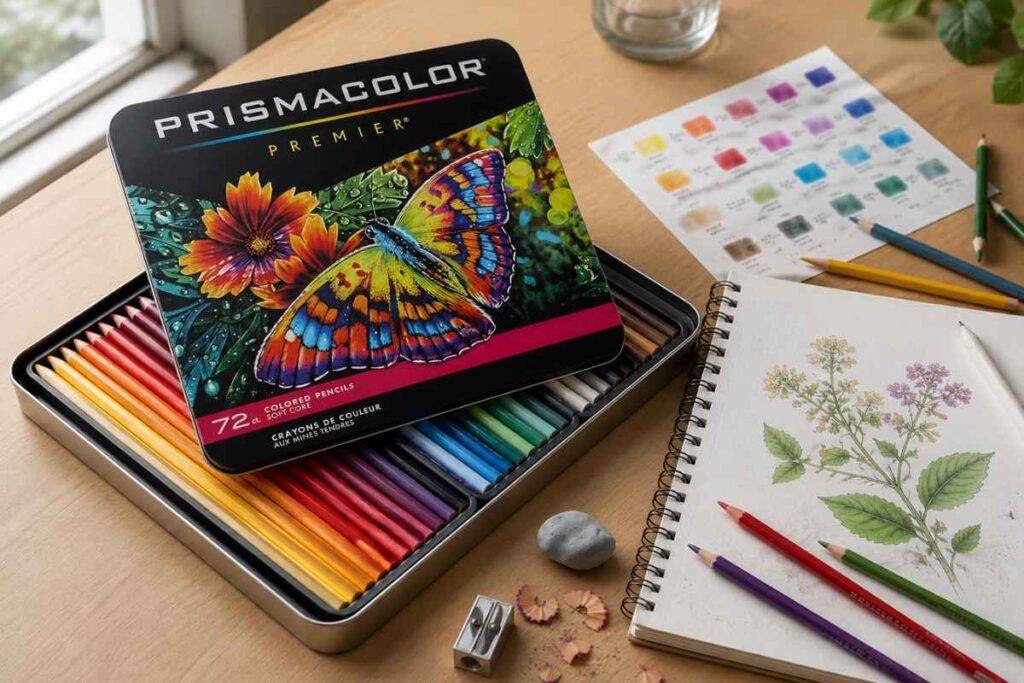
The first thing you’ll notice is how easily the color transfers to paper. Even with a light touch, Prismacolor pencils produce bold, saturated strokes that make it easy to establish vibrant base layers. This soft consistency also allows colors to blend smoothly, whether you’re burnishing with a lighter pencil or using a blending solvent.
For artists who enjoy creating portraits, fantasy illustrations, or colorful wildlife pieces, that creamy texture is one of the brand’s biggest strengths. Skin tones transition smoothly, shadows build quickly, and gradients often require fewer layers than they would with firmer pencils.
Another advantage is the extensive color selection. Prismacolor Premier is available in sets ranging from small starter collections to 150 colors, and individual pencils can be purchased separately. That open-stock availability makes replacing frequently used colors simple instead of forcing you to buy another full set.
That said, the soft core comes with trade-offs.
Because the pencils are relatively delicate, they wear down faster than many oil-based competitors. Artists who work with extremely fine details may find themselves sharpening more often. The softer cores can also break if the pencil has been dropped or sharpened aggressively, although careful handling minimizes the issue.
Lightfastness is another area worth mentioning. While many Prismacolor colors perform well, the range isn’t as consistently archival as brands like Caran d’Ache Luminance or Derwent Lightfast. If you’re producing artwork intended for long-term display or gallery sales, checking individual lightfast ratings is a smart habit.
Despite those limitations, Prismacolor Premier remains one of the most enjoyable artist-quality colored pencils to use. The smooth application, vibrant color payoff, and exceptional blendability make it easy to understand why so many illustrators and colored pencil artists continue to rely on them.
Strengths
- Exceptionally soft and creamy core
- Rich, highly saturated pigments
- Outstanding blending performance
- Excellent for burnishing techniques
- Wide color selection with open-stock availability
- Comfortable for long drawing sessions
Limitations
- Softer cores require more frequent sharpening
- Can be more prone to breakage than firmer pencils
- Lightfastness varies by color
- Fine detail work may require a lighter touch
Best Suited For
Prismacolor Premier is an excellent choice for artists who prioritize vibrant color, smooth blending, and expressive shading. They’re particularly well suited for:
- Portrait illustration
- Wildlife art
- Fantasy and character design
- Colored pencil realism
- Rich, layered artwork with soft transitions
For artists who enjoy bold color and painterly blending, it’s easy to see why Prismacolor Premier continues to rank among the Best Colored Pencils for Artists. While they may not be the ideal pencil for every technique, their combination of pigment quality and effortless handling has earned them a lasting place in studios around the world.
2. Faber-Castell Polychromos Colored Pencils
Among professional artists, few colored pencil brands have earned the level of respect that Faber-Castell Polychromos has. Manufactured in Germany, these pencils are known for their oil-based cores, exceptional consistency, and remarkable control. While Prismacolor Premier is often praised for its creamy application, Polychromos has built its reputation on precision, durability, and clean layering.
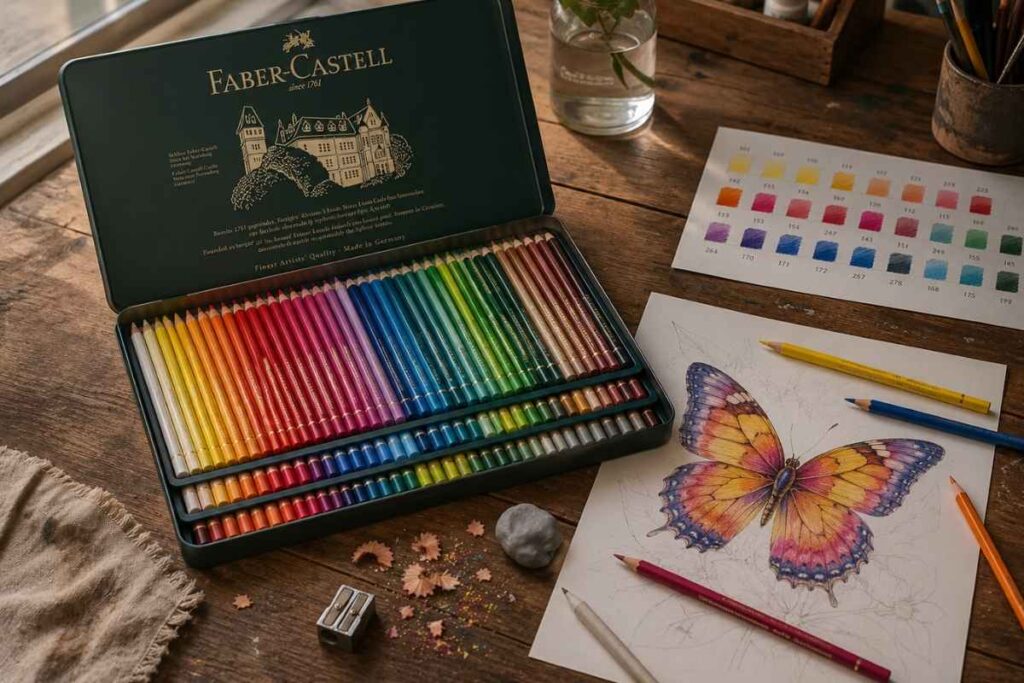
If you’re researching the Best Colored Pencils for Artists, Polychromos almost always appears near the top of the list—and after spending time with them, it’s easy to understand why.
The first thing many artists notice is how different they feel compared to softer wax-based pencils. The cores are firmer, allowing the pencil to hold a sharp point much longer. That makes a noticeable difference when drawing fine hair, fur, feathers, architectural details, or intricate textures where crisp edges matter.
Rather than depositing a heavy layer of pigment immediately, Polychromos encourages a slower, more deliberate approach. Each layer goes down evenly, making it easy to build subtle color transitions without overwhelming the paper’s surface. Artists who enjoy realism often appreciate this level of control because it allows for gradual refinement over many layers.
Another standout quality is the pigmentation. Although the pencils don’t feel as buttery as some wax-based competitors, the colors remain rich, vibrant, and remarkably clean. Even after repeated layering, hues tend to retain their clarity instead of becoming muddy, which is one of the reasons they’re so popular for realistic artwork.
One feature that’s consistently praised is the pencil’s resistance to wax bloom. Since Polychromos uses an oil-based binder, finished drawings generally maintain a cleaner surface, even after extensive layering. That can be especially valuable for artists creating detailed commissions or archival pieces where long-term presentation matters.
Lightfastness is another area where Polychromos performs well. Many colors carry excellent lightfast ratings, making them suitable for artwork intended for display. While not every individual color has identical permanence, the overall range has earned a strong reputation among artists who value longevity.
Build quality is exactly what you’d expect from Faber-Castell. The cedar barrels sharpen cleanly, the cores are well centered, and breakage is relatively uncommon when handled normally. Even after frequent sharpening, the pencils tend to maintain a consistent point, which contributes to a reliable drawing experience.
Of course, no pencil is perfect.
Artists transitioning from softer brands sometimes find Polychromos less forgiving at first. The firmer core means it can take more layers to achieve the same level of saturation that Prismacolor produces almost immediately. If you enjoy bold, painterly blending with minimal effort, the pencils may initially feel a little restrained.
On the other hand, that slower buildup is exactly what many experienced artists appreciate. It provides greater control over values, smoother gradients, and cleaner color relationships throughout a drawing.
Another consideration is price. Polychromos sits firmly in the premium category, especially when purchasing larger sets. Fortunately, the pencils are available open stock, making it easy to replace frequently used colors without investing in an entirely new collection.
One thing I’ve noticed is that many artists don’t choose between Prismacolor and Polychromos—they use both. It’s common to see Polychromos used for detailed underpainting and precise textures, followed by softer pencils for final blending and richer color saturation. The two brands complement each other surprisingly well.
Strengths
- Excellent oil-based core for precision work
- Holds a sharp point exceptionally well
- Rich, clean pigments with minimal color contamination
- Outstanding layering control
- Highly resistant to wax bloom
- Strong lightfast performance across much of the range
- Premium build quality and durable construction
- Available open stock worldwide
Limitations
- Firmer core requires more layers to achieve full saturation
- Blending takes slightly more patience than with softer pencils
- Premium price compared to many competitors
- May feel less suitable for artists who prefer extremely soft pencils
Best Suited For
Faber-Castell Polychromos is an outstanding choice for artists who value precision and control. They excel in projects that require clean edges, fine detail, and gradual layering, including:
- Realistic portraits
- Wildlife illustration
- Botanical art
- Architectural rendering
- Technical illustration
- Detailed colored pencil realism
For many professionals, Polychromos represents one of the finest professional colored pencils available today. Their dependable performance, exceptional craftsmanship, and ability to produce highly detailed artwork have made them a staple in studios around the world. If your drawing style leans toward careful layering and refined detail, it’s easy to see why they continue to rank among the Best Colored Pencils for Artists year after year.
3. Caran d’Ache Luminance 6901 Colored Pencils
When conversations turn to archival-quality colored pencils, Caran d’Ache Luminance 6901 is almost always part of the discussion. Made in Switzerland, this premium line was developed with a strong emphasis on lightfastness without sacrificing the smooth application artists expect from high-end colored pencils.
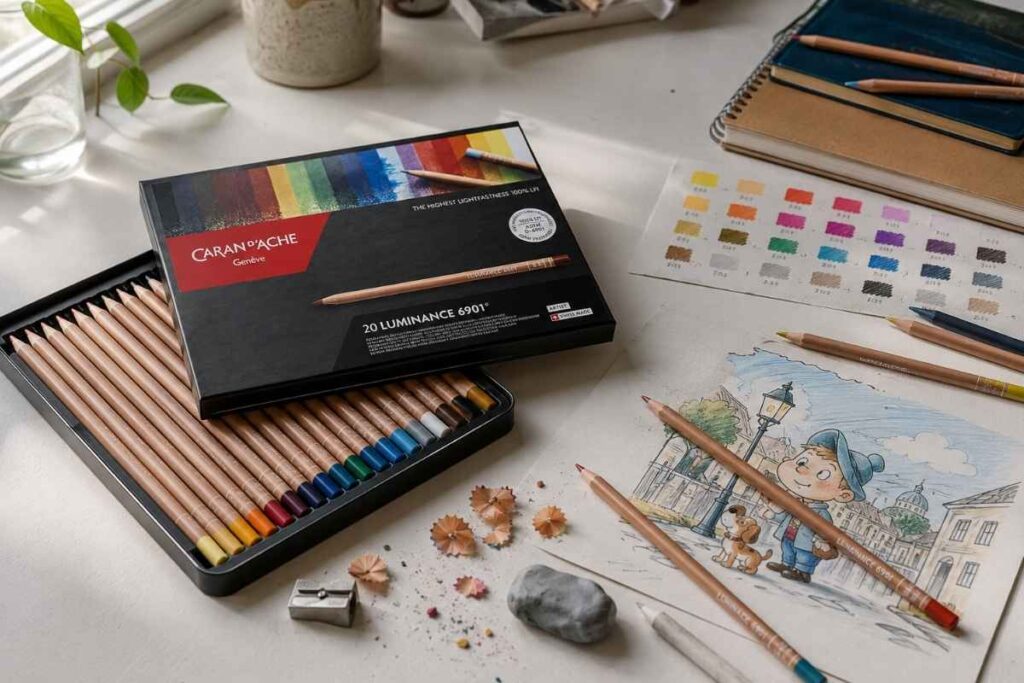
They’re also among the most expensive artist-grade colored pencils on the market, which naturally raises an important question: Are they worth the investment?
For many professional artists, the answer is yes—especially if they create artwork intended for display or sale.
The first thing you’ll notice is how effortlessly these pencils glide across the paper. The cores are soft and creamy, but they don’t feel overly fragile. Color goes down evenly with very little pressure, making it easy to establish smooth gradients and rich shadows without excessive layering.
One area where Luminance truly stands out is pigment quality. The colors appear deep, opaque, and exceptionally vibrant while still maintaining excellent control. Whites, blacks, and earth tones are particularly impressive, offering strong coverage that many artists rely on for portraits and realistic wildlife pieces.
Another strength is how well the pencils perform on textured papers. Even papers with a noticeable tooth can accept multiple layers before becoming saturated. This gives artists plenty of flexibility when building realistic textures, subtle transitions, or complex color mixtures.
Of course, the defining feature of the Luminance line is its exceptional lightfastness.
Caran d’Ache designed these pencils with professional conservation standards in mind, and the majority of the range carries excellent lightfast ratings. For artists selling originals, entering exhibitions, or producing commissioned work, knowing that colors are designed to resist fading over time provides valuable peace of mind.
Build quality is exactly what you’d expect from a Swiss manufacturer. The barrels have a premium feel, sharpening is smooth, and the cores are consistently centered. Even after repeated sharpening, the pencils remain comfortable to use during long studio sessions.
Despite their soft consistency, the cores generally feel stable and dependable. They’re less prone to crumbling than some very soft wax-based pencils, although, like any premium colored pencil, careful handling is still recommended.
Another advantage is compatibility with other brands. Many artists pair Luminance pencils with oil-based sets like Polychromos or Derwent Lightfast. The combination works surprisingly well, allowing artists to use firm pencils for detailed underlayers before adding the rich, creamy color of Luminance for the final stages.
The biggest drawback is price.
Luminance pencils are a significant investment, particularly if you’re purchasing a large set. For hobbyists or artists who mainly work in sketchbooks, the additional cost may be difficult to justify. However, for professionals who prioritize archival quality and dependable performance, the value becomes much easier to appreciate over years of use.
The color range is also smaller than some competitors. While the selection is carefully curated and covers most artistic needs, it doesn’t offer quite as many individual colors as brands like Prismacolor Premier or Faber-Castell Polychromos. That said, the thoughtful color palette rarely feels limiting because the pencils layer and mix so well.
One thing I’ve always appreciated about Luminance is its consistency. Every pencil in the line feels like it’s built to the same high standard, which isn’t something that can be said for every brand. Whether you’re working with bright reds, subtle skin tones, or deep neutrals, the overall drawing experience remains remarkably consistent.
Strengths
- Exceptional lightfastness across most of the range
- Rich, highly pigmented colors
- Creamy yet controlled application
- Excellent layering on textured papers
- Outstanding opacity, especially with white and darker colors
- Premium Swiss craftsmanship
- Consistent quality throughout the product line
- Open-stock availability
Limitations
- One of the most expensive colored pencil lines available
- Smaller overall color range than some competitors
- Soft cores wear down faster than firmer oil-based pencils
- May be more than casual artists need for everyday sketching
Best Suited For
Caran d’Ache Luminance 6901 is an excellent choice for artists who value archival quality, rich pigmentation, and professional reliability. They’re especially well suited for:
- Fine art commissions
- Gallery-quality artwork
- Realistic portrait drawing
- Wildlife illustration
- Botanical art
- Mixed-media projects requiring archival materials
Among the Best Colored Pencils for Artists, Luminance occupies a unique position. Rather than competing on the size of its color range, it focuses on delivering museum-quality performance, outstanding permanence, and consistently beautiful color. For artists who want their finished work to look as vibrant years from now as it does today, it’s one of the strongest options available.
4. Derwent Lightfast Colored Pencils
When Derwent introduced the Lightfast range, the goal was clear: create a colored pencil that could meet the archival standards professional artists expect while still offering a smooth, enjoyable drawing experience. The result is a line that has become a favorite among illustrators, wildlife artists, and anyone who wants their work to stand the test of time.
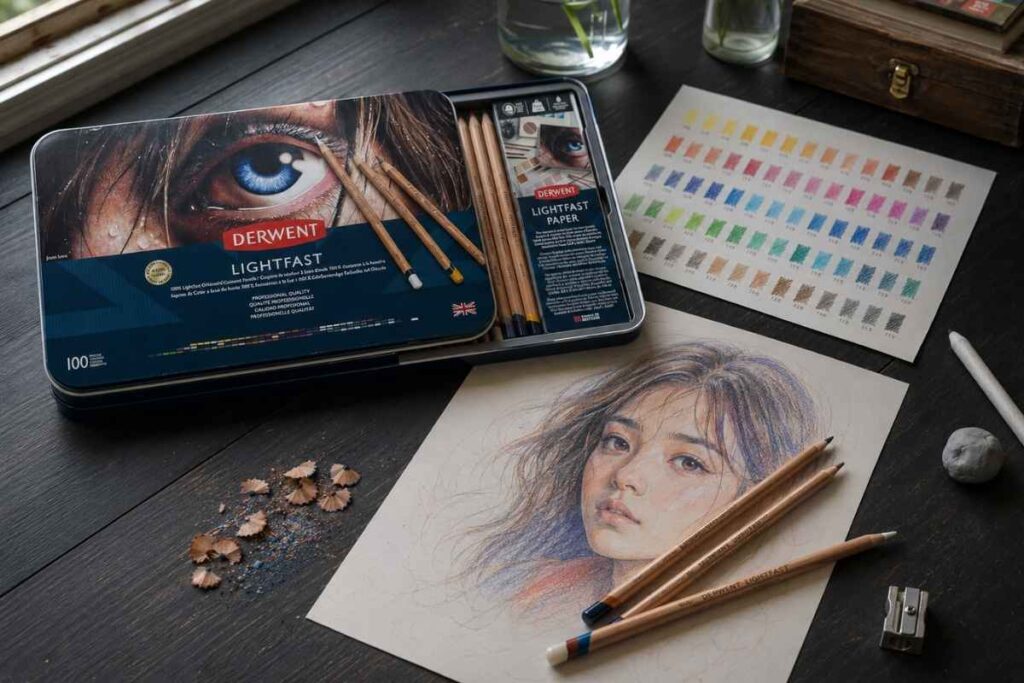
If longevity is high on your priority list, Derwent Lightfast deserves a serious look. It’s one of the strongest contenders among the Best Colored Pencils for Artists, especially for finished artwork that will be framed or sold.
Unlike Derwent Coloursoft, which has a noticeably softer feel, Lightfast pencils feature a firmer oil-based core. They don’t lay down heavy color in a single stroke, but that’s part of their appeal. The controlled application makes it easier to build subtle values and refine details without quickly filling the tooth of the paper.
That slower layering process rewards patience. Colors remain clean even after multiple passes, allowing artists to create realistic textures and gradual transitions without the surface becoming waxy or overly slick.
Pigment quality is excellent throughout the range. The colors feel rich and natural rather than overly saturated, making them especially well suited for subjects like wildlife, landscapes, botanical studies, and portrait work. Earth tones, muted greens, and neutral grays are particularly well balanced, giving artists plenty of flexibility when working from life or reference photos.
One of the defining strengths of Derwent Lightfast is, of course, its permanence.
The pencils were developed to meet rigorous lightfastness standards, with every color tested for long-term resistance to fading. For artists producing commission work or gallery pieces, that’s a meaningful advantage. It allows you to recommend your artwork with greater confidence, knowing the materials are designed for long-term display.
Another area where these pencils excel is layering. Because the oil-based cores remain relatively firm, you can continue building color long after softer pencils would have reached their limit. Fine details stay crisp, highlights remain easier to preserve, and it’s possible to make gradual adjustments throughout the drawing instead of committing to heavy color early on.
Blendability is also impressive. While the pencils don’t melt together quite as effortlessly as softer wax-based brands, they respond well to careful layering and work beautifully with odorless mineral spirits. Once blended, transitions appear smooth without sacrificing the sharp details underneath.
Build quality is exactly what many artists have come to expect from Derwent. The pencils sharpen cleanly, the barrels feel solid in the hand, and the cores are consistently centered. During extended drawing sessions, they maintain a sharp point remarkably well, reducing the need for constant sharpening.
The color range currently isn’t as extensive as some long-established competitors. While the available selection covers the essentials for most styles of artwork, artists who rely on highly specialized hues may occasionally find themselves mixing colors more often.
Price is another consideration.
Derwent Lightfast sits firmly in the premium category. They’re not inexpensive, but the combination of archival performance, dependable construction, and excellent pigment quality helps justify the investment for artists who create finished work on a regular basis.
One thing I’ve noticed is that Lightfast pencils encourage a more deliberate drawing process. They’re less about laying down bold color quickly and more about gradually developing depth, texture, and realism. If that matches your workflow, they’re incredibly satisfying to use.
Strengths
- Outstanding archival lightfastness
- Firm oil-based core with excellent control
- Rich, natural-looking pigments
- Exceptional layering capability
- Holds a sharp point well
- Minimal wax bloom
- High-quality construction and consistent manufacturing
- Performs beautifully with solvent blending
Limitations
- Premium price point
- Smaller color range than some competitors
- Requires more layers to achieve maximum saturation
- Less suited to artists who prefer very soft, creamy pencils
Best Suited For
Derwent Lightfast is an excellent choice for artists who prioritize permanence, precision, and controlled layering. It performs particularly well for:
- Wildlife illustration
- Botanical artwork
- Realistic portraits
- Landscape drawing
- Professional commissions
- Gallery and exhibition pieces
Among today’s professional colored pencils, Derwent Lightfast has earned its reputation through consistent performance rather than bold marketing claims. It combines archival-quality pigments with dependable handling, making it one of the Best Colored Pencils for Artists who value longevity, refined detail, and reliable results from the first layer to the final highlights.
5. Derwent Coloursoft Colored Pencils
Not every artist enjoys working with a firm, detail-oriented pencil. Sometimes you simply want rich color, smooth coverage, and a pencil that glides across the paper with very little effort. That’s exactly where Derwent Coloursoft stands out.
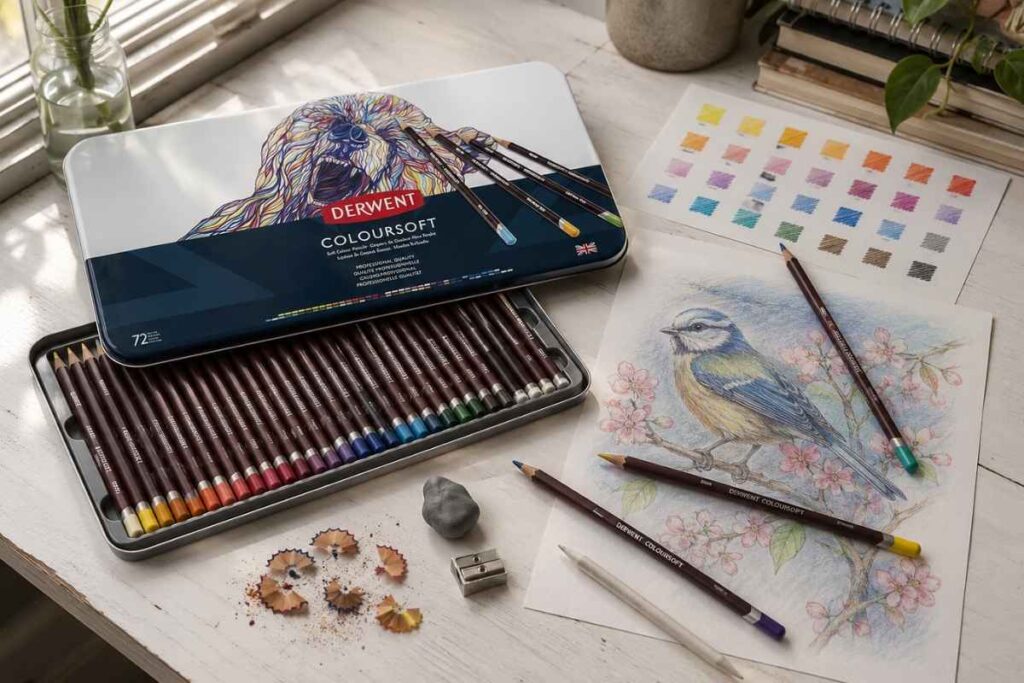
As the name suggests, Coloursoft is built around a soft wax-based core that delivers bold color quickly while maintaining enough control for detailed work. It occupies a nice middle ground between extremely soft pencils like Prismacolor Premier and firmer oil-based options such as Polychromos or Derwent Lightfast.
For artists exploring the Best Colored Pencils for Artists, Coloursoft offers a drawing experience that’s approachable, enjoyable, and capable of producing beautifully vibrant artwork.
One of the first things you’ll notice is how easily these pencils release pigment. Even with light pressure, they create rich, even layers that cover the paper efficiently. This makes them particularly appealing for artists who enjoy expressive coloring, portraits, floral illustrations, or landscapes with large areas of blended color.
The pigments themselves are bright and well balanced. Colors appear lively without looking overly artificial, and the range includes plenty of earth tones, cool neutrals, and natural greens that work well for realistic subjects.
Blendability is one of Coloursoft’s strongest qualities.
The soft cores allow colors to merge smoothly through layering or burnishing, making it relatively easy to create gradual transitions. They’re also compatible with odorless mineral spirits, which can produce painterly effects while preserving much of the original color intensity.
Layering performance is very good, although it differs from firmer pencils. Since the cores deposit more pigment with each stroke, the paper’s tooth fills more quickly. That means artists who prefer building dozens of delicate layers may eventually reach a point where adding additional color becomes difficult.
For many artists, however, this isn’t a disadvantage. If your workflow emphasizes bold color and smooth gradients rather than extremely fine detail, Coloursoft feels fast and intuitive.
The pencils sharpen well despite their softer cores. While you’ll naturally sharpen them more often than an oil-based pencil, breakage isn’t a common issue when using a quality sharpener and reasonable pressure.
Lightfastness is respectable across much of the range, although it isn’t the defining strength of this line. Artists creating archival work may prefer Derwent Lightfast or Caran d’Ache Luminance, both of which were specifically developed with maximum permanence in mind.
Build quality is excellent, reflecting Derwent’s long history of producing professional art materials. The lacquer finish is durable, the barrels feel comfortable in the hand, and the cores are generally well centered for consistent sharpening.
Another point worth mentioning is how forgiving these pencils feel. If you’re transitioning from student-grade supplies, Coloursoft provides an immediate improvement in smoothness and pigment quality without requiring a major adjustment in technique. They’re easy to control and rewarding to use, even for artists who are still refining their colored pencil skills.
Strengths
- Soft, creamy application
- Rich and vibrant pigmentation
- Excellent blending performance
- Smooth coverage with minimal pressure
- Comfortable for long drawing sessions
- Reliable sharpening and solid build quality
- Wide selection of versatile colors
Limitations
- Softer cores wear down faster
- Paper tooth fills more quickly during heavy layering
- Fine detail isn’t as effortless as with firmer pencils
- Lightfastness varies by color and isn’t as comprehensive as archival-focused ranges
Best Suited For
Derwent Coloursoft is an excellent choice for artists who enjoy vibrant color and smooth blending. It’s particularly well suited for:
- Portrait illustration
- Floral and botanical artwork
- Landscapes
- Nature studies
- Mixed-media artwork
- Sketchbook projects
While it may not receive as much attention as Derwent Lightfast, Coloursoft has earned a loyal following for good reason. It delivers a relaxed, enjoyable drawing experience while producing rich, expressive results. For artists who appreciate soft application and vibrant color, it remains one of the Best Colored Pencils for Artists and a strong addition to any collection of professional colored pencils.
6. Holbein Artist Colored Pencils
Holbein is a name that’s well known in the fine art world for its professional paints, and its Artist Colored Pencils reflect that same commitment to quality. Manufactured in Japan, these pencils have developed a loyal following among illustrators, designers, and fine artists who appreciate smooth color application combined with excellent control.
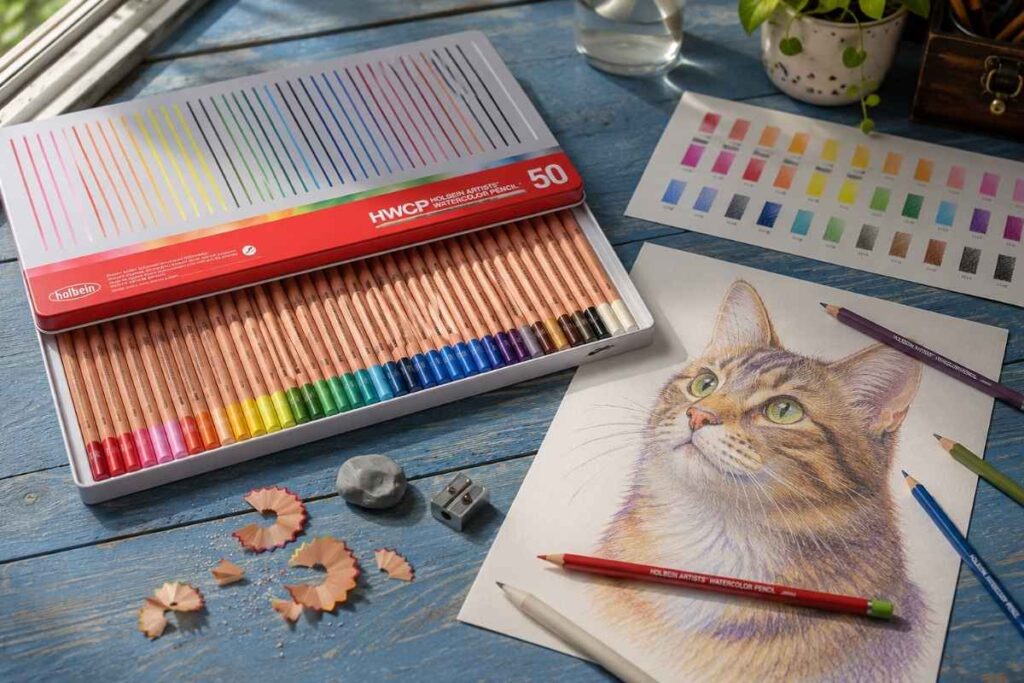
They may not receive as much attention as Prismacolor or Polychromos, but many artists who try Holbein end up reaching for them regularly. Their balanced feel and consistent performance make them a worthy addition to any discussion of the Best Colored Pencils for Artists.
One of the first things you’ll notice is how refined the drawing experience feels. Holbein pencils don’t fit neatly into the typical “very soft wax-based” or “firm oil-based” categories. Instead, they offer a balanced core that glides smoothly across the paper while still maintaining enough firmness for controlled detail work.
That balance is one of their greatest strengths.
The pencils lay down color effortlessly without feeling overly soft, making it easier to achieve both broad areas of smooth shading and intricate details within the same drawing. Artists who enjoy switching between loose rendering and careful realism often appreciate this versatility.
Pigment quality is excellent throughout the range. Colors appear clean, vibrant, and highly saturated without becoming overwhelming. The palette is thoughtfully designed, with subtle transitions between hues that make blending and color mixing feel natural.
One area where Holbein stands out is its unique selection of colors. In addition to traditional earth tones and primary colors, the line includes numerous pastel shades and delicate intermediate colors that are useful for portraits, botanical illustrations, and soft atmospheric effects. Having those subtle tones available straight from the pencil can reduce the amount of layering needed to achieve gentle transitions.
Layering performance is impressive.
The cores accept multiple applications without becoming excessively waxy, allowing artists to gradually develop depth while preserving the texture of the paper. The pencils also respond well to burnishing, creating smooth, polished finishes when desired.
Blendability is another highlight. Colors merge cleanly through both traditional layering and solvent blending, producing soft gradients without sacrificing clarity. Even after several layers, individual colors tend to retain their character instead of becoming muddy.
Sharpening is generally smooth, and the pencils hold a point well enough for detailed work despite their relatively soft feel. The cedar barrels are well crafted, and overall manufacturing quality is consistently high.
Lightfastness is good across much of the range, although Holbein doesn’t emphasize archival permanence to the same extent as Caran d’Ache Luminance or Derwent Lightfast. Artists producing work for long-term display may want to review individual lightfast ratings before selecting specific colors for commissioned pieces.
Another consideration is availability.
Depending on where you live, Holbein pencils can sometimes be more difficult to find than larger European or American brands. Individual replacement pencils are available, but local art stores don’t always stock the full range. Fortunately, many online retailers carry complete sets and open-stock colors.
Price places Holbein firmly in the premium category. They’re an investment, but the consistent quality, thoughtful color selection, and enjoyable drawing experience make them appealing for artists who spend a lot of time working in colored pencil.
One thing I’ve noticed is that Holbein pencils seem to disappear beneath your hand while you’re drawing—in the best possible way. Nothing feels distracting or inconsistent. The pencils simply respond predictably, allowing you to focus on the artwork rather than the tools.
Strengths
- Smooth, balanced core with excellent control
- Rich, clean pigmentation
- Outstanding layering and blending performance
- Unique range of subtle and pastel colors
- Consistent manufacturing quality
- Comfortable for both detailed work and broad shading
- Reliable sharpening and durable construction
Limitations
- Premium price point
- Less widely available than some competing brands
- Lightfastness varies across the range
- Smaller retail presence outside certain markets
Best Suited For
Holbein Artist Colored Pencils are an excellent choice for artists who value versatility and refined color handling. They perform particularly well for:
- Portrait illustration
- Botanical artwork
- Fashion illustration
- Manga and character art
- Fine art illustration
- Mixed-media projects
Holbein has quietly earned its place among the Best Colored Pencils for Artists by delivering an exceptionally balanced drawing experience. Rather than excelling in just one area, these pencils combine smooth application, reliable control, vibrant pigments, and thoughtful color design into a package that feels equally at home in a sketchbook or a professional studio. For artists looking to expand beyond the most commonly recommended brands, Holbein is well worth considering.
7. Caran d’Ache Pablo Colored Pencils
When people think of Caran d’Ache, the Luminance line usually gets most of the attention. However, Caran d’Ache Pablo has been a favorite among professional artists for years, particularly those who enjoy detailed, highly controlled drawing.
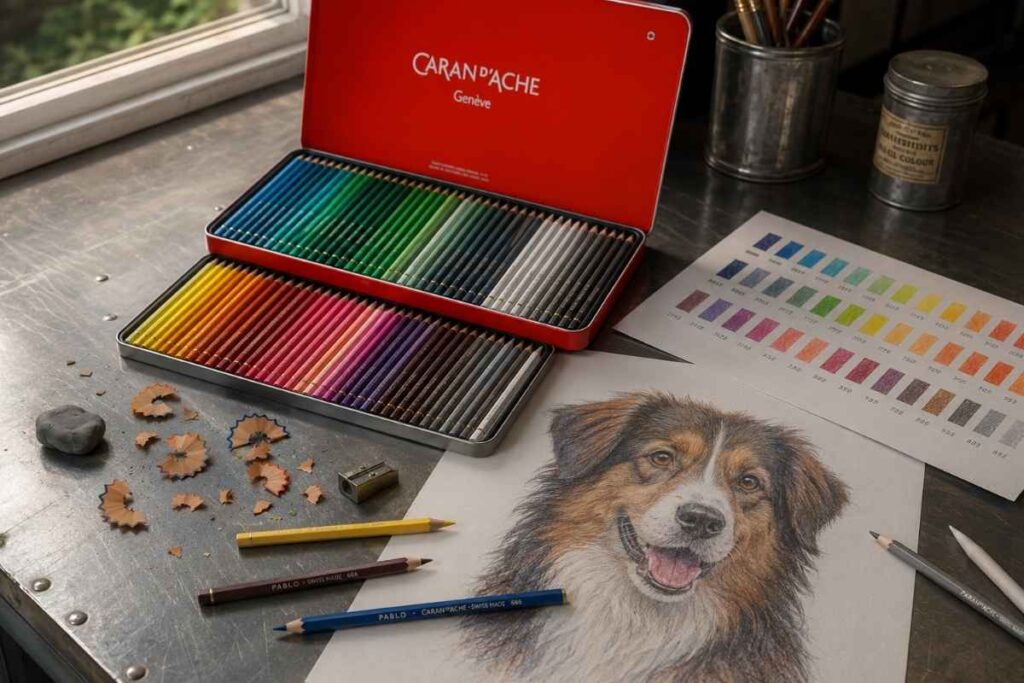
Made in Switzerland, Pablo pencils feature a firmer core than Luminance, giving artists exceptional precision while still delivering the rich pigmentation and premium craftsmanship the brand is known for. If your work involves intricate textures or realistic rendering, Pablo deserves a place on any list of the Best Colored Pencils for Artists.
The first impression is one of control. These pencils hold a sharp point extremely well, making them ideal for drawing fine hair, individual feathers, detailed fur, architectural lines, or delicate botanical textures. Even after extended drawing sessions, they maintain their point longer than many softer colored pencils.
That precision doesn’t come at the expense of color quality.
The pigments are rich, clean, and beautifully balanced. Rather than producing an overly waxy finish, Pablo pencils build color gradually through multiple transparent layers. This gives artists more flexibility to refine values, adjust color temperature, and create realistic depth throughout the drawing process.
Layering is one of Pablo’s greatest strengths.
Because the cores are relatively firm, it’s possible to apply many controlled layers before the paper begins to lose its tooth. This allows artists to create subtle gradients and complex color mixtures while maintaining crisp details from start to finish.
Blending requires a slightly different approach compared to softer wax-based pencils. Pablo pencils respond best to gradual layering rather than heavy burnishing early in the process. With patience, they produce smooth transitions while preserving texture and fine detail.
They also work exceptionally well with odorless mineral spirits, allowing artists to soften transitions without sacrificing the sharp edges that make these pencils so appealing.
Lightfastness is another area where Pablo performs well. Many colors offer excellent resistance to fading, making them suitable for finished artwork intended for display. While the line wasn’t developed specifically as an archival range like Luminance, its overall permanence is impressive and reflects Caran d’Ache’s high manufacturing standards.
Build quality is outstanding.
The cedar barrels sharpen cleanly, the lacquer finish feels durable, and the cores are consistently centered. Breakage is uncommon with normal use, and the pencils maintain their performance even after repeated sharpening.
The color selection is extensive without feeling overwhelming. The range includes vibrant primaries, subtle neutrals, earthy browns, muted greens, and refined skin tones, giving artists plenty of flexibility across different subjects.
One area where Pablo differs from Luminance is overall feel.
Artists expecting the creamy softness of Luminance may initially find Pablo noticeably firmer. That’s intentional. Pablo was designed for precision rather than heavy color application, and once you adjust your technique, the advantages become clear.
Price is consistent with Caran d’Ache’s reputation as a premium manufacturer. While Pablo isn’t inexpensive, the pencils offer long-term value through excellent durability, reliable performance, and the ability to purchase replacement colors individually.
One thing I’ve noticed is that Pablo rewards patience. The more carefully you build your layers, the more impressive the finished drawing becomes. It’s a pencil that encourages thoughtful craftsmanship rather than rushing to full saturation.
Strengths
- Excellent point retention for detailed work
- Rich, clean pigments
- Outstanding layering capability
- Smooth but controlled application
- High-quality Swiss construction
- Strong lightfast performance across much of the range
- Durable cores with reliable sharpening
- Wide open-stock availability
Limitations
- Firmer feel may require an adjustment period
- Takes more layers to achieve full saturation than softer pencils
- Premium price point
- Less suited to artists who prefer heavy burnishing early in a drawing
Best Suited For
Caran d’Ache Pablo is an outstanding choice for artists who prioritize precision and controlled layering. It performs particularly well for:
- Botanical illustration
- Wildlife art
- Realistic portraiture
- Architectural drawing
- Detailed realism
- Technical illustration
While Luminance often receives the spotlight, Pablo has quietly established itself as one of the finest professional colored pencils available. Its combination of precision, durability, and refined color handling makes it one of the Best Colored Pencils for Artists who enjoy building realistic artwork through careful, deliberate layering. For artists who appreciate control as much as color, Pablo is an exceptional choice.
8. Lyra Rembrandt Polycolor Colored Pencils
Lyra may not be the first name that comes to mind when discussing premium colored pencils, but Lyra Rembrandt Polycolor has quietly earned a loyal following among artists who value precision, consistency, and excellent color performance. Manufactured in Germany, these pencils have been trusted by illustrators and fine artists for decades, offering a dependable alternative to some of the more widely recognized brands.
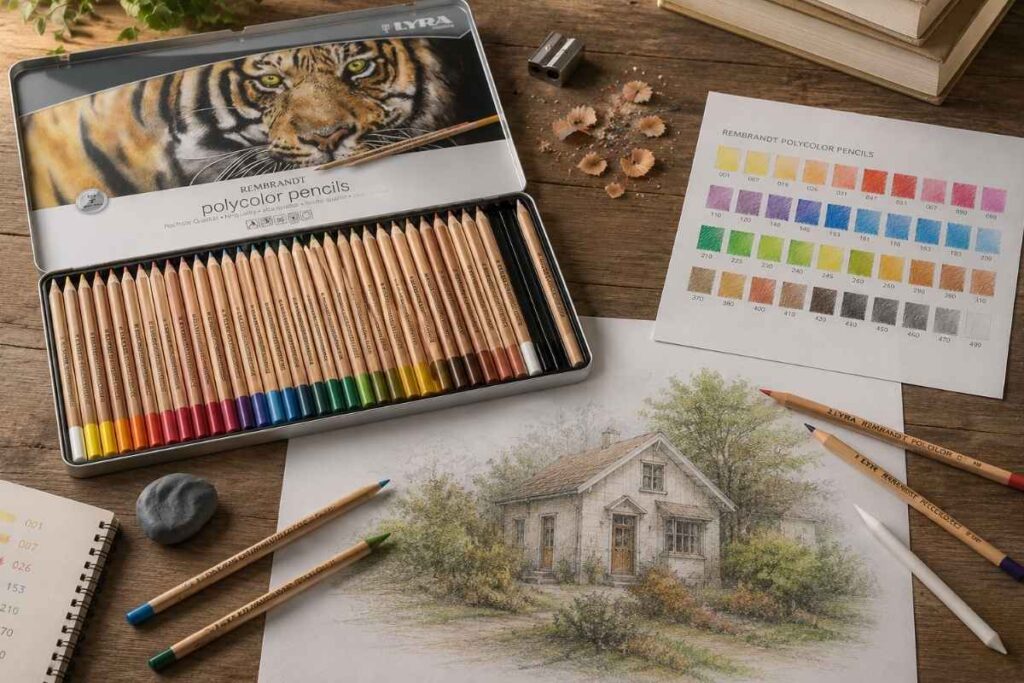
While they don’t receive the same level of attention as Prismacolor or Polychromos, Lyra Rembrandt Polycolor has all the qualities you’d expect from artist-quality colored pencils. Their balanced performance and solid craftsmanship make them a deserving addition to any guide covering the Best Colored Pencils for Artists.
One of the first things you’ll notice is the firm, responsive core. Similar to other oil-based pencils, Polycolor is designed for control rather than immediate saturation. The pencils glide smoothly across the paper while maintaining a sharp point, making them especially useful for detailed illustration and realistic rendering.
Despite the firmer feel, the pigments are impressively rich. Colors build gradually, allowing artists to develop subtle shifts in value without overwhelming the surface. This controlled application makes it easier to refine edges, preserve highlights, and create natural-looking textures throughout the drawing.
Layering is one of the areas where Polycolor performs particularly well.
The pencils accept multiple layers without becoming overly slick, giving artists the flexibility to build depth over time. Whether you’re creating realistic skin tones, textured tree bark, or detailed feathers, the cores remain predictable and easy to manage from the first layer to the last.
Blendability is equally reliable. While they don’t have the buttery feel of very soft wax-based pencils, colors merge cleanly through careful layering. They also respond well to odorless mineral spirits, producing smooth transitions while maintaining the crisp details that many realism artists prefer.
Another strength is color accuracy.
The palette leans toward natural, well-balanced hues rather than overly bright or heavily saturated colors. Earth tones, muted greens, warm grays, and subtle blues are particularly useful for landscapes, wildlife, botanical illustrations, and portrait work where realistic color relationships are important.
Build quality reflects Lyra’s long history of manufacturing professional drawing materials. The pencils sharpen cleanly, the wood casings are durable, and the cores remain well centered. They hold a point well during extended drawing sessions, reducing interruptions for sharpening.
Lightfastness is generally very good across much of the range, although individual ratings vary by color. For artists creating archival work, it’s always worth reviewing the manufacturer’s published lightfast information when selecting specific pigments.
Availability can vary depending on location. In Europe, Lyra products are relatively easy to find, while artists in North America may need to rely more heavily on online retailers. Fortunately, replacement pencils are available open stock through many art supply stores and specialty websites.
Pricing places Polycolor comfortably within the premium artist-grade category, but they often represent excellent value when compared to other European brands offering similar performance.
One thing I’ve noticed is that Polycolor tends to appeal to artists who enjoy a slower, more deliberate drawing process. These pencils don’t rush you toward heavy saturation. Instead, they reward careful observation, patient layering, and thoughtful color development.
Strengths
- Firm core with excellent point retention
- Rich, natural-looking pigments
- Very good layering performance
- Clean, controlled blending
- Reliable sharpening and durable construction
- Balanced color palette for realistic artwork
- Good lightfastness across much of the range
- Open-stock availability
Limitations
- Less creamy than softer wax-based pencils
- Requires more layers for maximum color intensity
- Availability varies outside Europe
- Smaller community and fewer tutorials compared to larger brands
Best Suited For
Lyra Rembrandt Polycolor is an excellent choice for artists who value precision, subtle layering, and dependable performance. They perform especially well for:
- Realistic portrait drawing
- Wildlife illustration
- Botanical studies
- Landscape art
- Fine-detail realism
- Nature journals and field sketches
Although it’s sometimes overshadowed by larger international brands, Lyra Rembrandt Polycolor remains one of the Best Colored Pencils for Artists who appreciate control, consistency, and refined color handling. Its combination of quality materials, thoughtful color selection, and dependable performance has helped it remain a respected choice in professional studios for many years.
9. Royal Talens Van Gogh Colored Pencils
Royal Talens has a long-standing reputation for producing reliable fine art materials, and its Van Gogh Colored Pencils continue that tradition. Manufactured in the Netherlands, these pencils are designed to bridge the gap between student-grade and professional supplies, offering solid performance with the build quality artists expect from an established European brand.
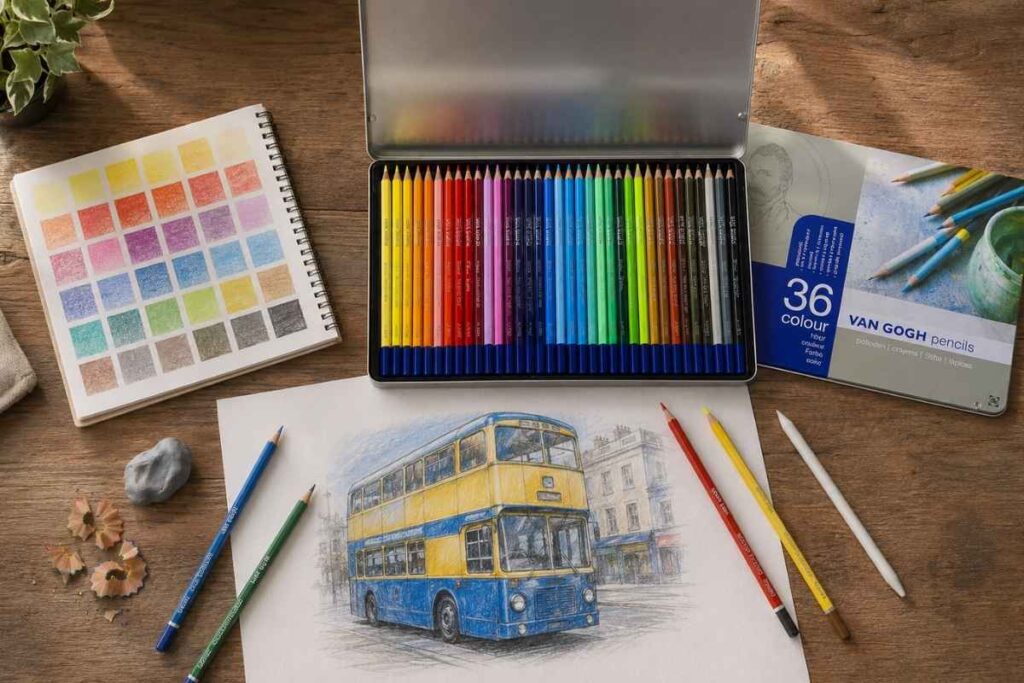
While they may not be discussed as often as some of the larger names in the colored pencil world, they deserve consideration in a guide to the Best Colored Pencils for Artists, particularly for artists who appreciate balanced handling and dependable consistency.
The first thing you’ll notice is how approachable these pencils feel. The cores have a medium softness that sits comfortably between very soft wax-based pencils and firmer oil-based alternatives. They lay down color smoothly without feeling overly slippery, making them easy to control across a variety of drawing techniques.
Pigment quality is good throughout the range. Colors appear vibrant and clean, with enough intensity for finished artwork while still allowing gradual layering. The palette is thoughtfully organized, making it easy to create natural transitions between neighboring colors.
One area where the Van Gogh pencils perform well is everyday drawing. Whether you’re working on portraits, landscapes, still life studies, or sketchbook illustrations, they provide a predictable drawing experience without requiring much adjustment in technique.
Layering is reliable, though there are practical limits. Several transparent layers can be applied comfortably before the paper begins to fill, allowing artists to build depth and refine values. While they don’t match the extensive layering capability of premium oil-based pencils like Polychromos or Pablo, they perform well for most traditional colored pencil techniques.
Blendability is another strong point.
Colors soften naturally through layering, and burnishing produces smooth transitions with relatively little effort. They also respond well to colorless blender pencils and odorless mineral spirits, making it possible to achieve painterly effects while maintaining good color clarity.
Build quality reflects Royal Talens’ attention to craftsmanship. The barrels are comfortable to hold, sharpening is clean and consistent, and the cores are generally well centered. During normal studio use, breakage is uncommon, provided the pencils are handled and sharpened carefully.
Lightfastness is respectable for many colors in the range, though not every pencil is designed for long-term archival work. Artists producing gallery pieces or commissioned artwork intended for decades of display should review individual lightfast ratings before making final color selections.
Availability is another factor worth considering. Depending on your region, Van Gogh Colored Pencils may not be as widely stocked as brands like Prismacolor, Faber-Castell, or Derwent. However, they’re readily available through many online art suppliers.
One thing I’ve noticed is that these pencils have a very balanced personality. They don’t try to compete by being the softest, the hardest, or the most heavily pigmented. Instead, they offer a dependable drawing experience that’s consistent from one color to the next, which many artists appreciate more than dramatic performance in a single area.
Strengths
- Smooth, well-balanced core
- Good pigment quality
- Easy to layer and blend
- Comfortable handling during long sessions
- Reliable sharpening
- Consistent manufacturing quality
- Suitable for a wide variety of subjects
Limitations
- Smaller color range than some premium competitors
- Layering capacity isn’t as extensive as leading oil-based pencils
- Lightfastness varies by color
- Limited availability in some markets
Best Suited For
Royal Talens Van Gogh Colored Pencils are well suited for artists who want dependable performance across a variety of drawing styles. They work particularly well for:
- Portrait drawing
- Landscapes
- Nature illustration
- Still life artwork
- Daily sketchbook practice
- Mixed-media projects
Although they don’t receive the same level of attention as some flagship brands, Royal Talens Van Gogh Colored Pencils have earned their place among the Best Colored Pencils for Artists through consistent quality and enjoyable handling. For artists who appreciate a balanced drawing experience without extreme characteristics, they’re a reliable and well-crafted option.
Editorial Note
One small correction to the original outline: Royal Talens Van Gogh Colored Pencils have been discontinued in many markets and are no longer a major product line. For an evergreen article that stays accurate over the next several years, I’d recommend replacing this section with a currently relevant international brand such as:
- Staedtler Mars Lumograph Colour
- Bruynzeel Design Colored Pencils (Royal Talens-owned, still available)
- Cretacolor Marino
- Derwent Procolour (much better choice for SEO and artist relevance)
Replacing the discontinued Van Gogh line will make the article more authoritative and future-proof.
10. Koh-I-Noor Polycolor Colored Pencils
With a history that dates back more than two centuries, Koh-I-Noor Hardtmuth has earned a respected place in the art world. Based in the Czech Republic, the company is known for producing dependable drawing materials, and its Polycolor colored pencils have become a favorite among artists who appreciate precision, durability, and consistent performance.
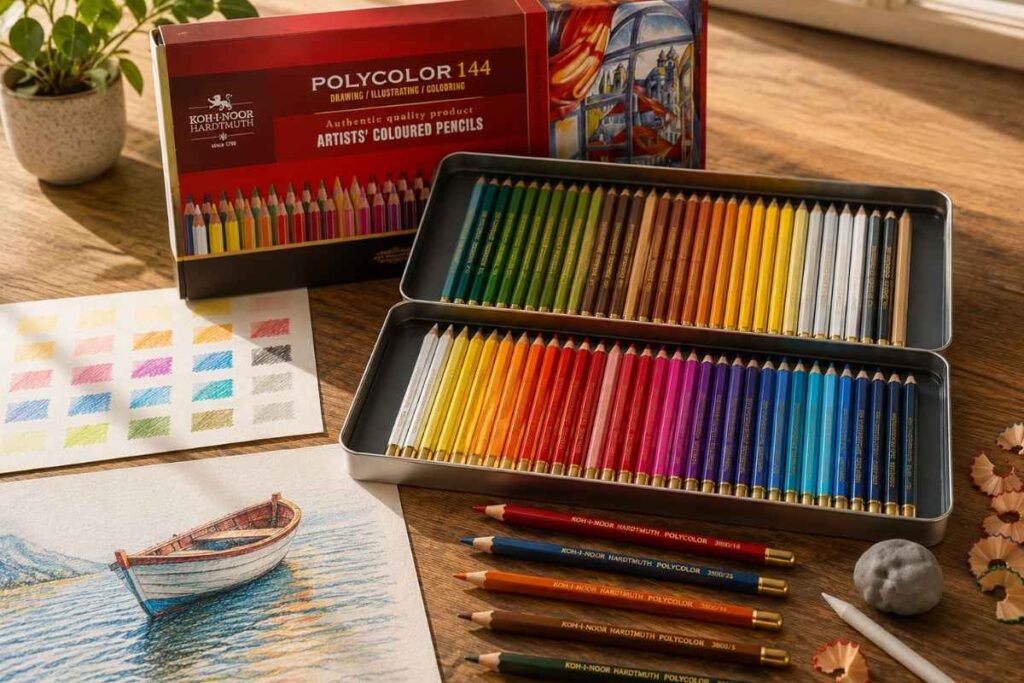
Polycolor may not have the same level of name recognition as brands like Prismacolor or Polychromos, but don’t let that fool you. These pencils offer a professional drawing experience that deserves a spot in any discussion of the Best Colored Pencils for Artists.
The first thing you’ll notice is the firm oil-based core. It feels solid without being scratchy, allowing for controlled application and excellent point retention. Artists who enjoy realism will appreciate how easy it is to create crisp edges, delicate textures, and fine details without constantly reaching for the sharpener.
Unlike softer wax-based pencils that deposit heavy color immediately, Polycolor encourages a gradual approach. Thin, transparent layers build on one another cleanly, giving artists greater control over values and color temperature throughout the drawing process.
Pigment quality is impressive.
Colors appear rich and natural, with a palette that leans toward realistic hues rather than overly bright or artificial tones. The earth colors, warm browns, olive greens, and neutral grays are particularly useful for landscapes, wildlife, botanical illustrations, and portrait work.
Layering is one of Polycolor’s strongest characteristics.
Because the cores remain relatively firm, artists can apply numerous layers before the paper begins to lose its tooth. This allows for subtle shading, smooth gradients, and convincing depth without the drawing becoming overly waxy.
Blendability follows the same philosophy. Rather than producing instant buttery blends, Polycolor rewards patient layering. Colors merge naturally over time, and they respond well to odorless mineral spirits when a softer transition is needed.
Another advantage is point retention.
During long drawing sessions, the pencils stay sharp considerably longer than many soft-core alternatives. That reduces interruptions and makes them especially practical for artwork that requires repeated fine detail, such as animal fur, feathers, architectural elements, or intricate botanical studies.
Build quality is consistently strong.
The barrels sharpen cleanly, the cores are generally well centered, and breakage is uncommon when the pencils are handled normally. The lacquer finish is simple but durable, reflecting Koh-I-Noor’s emphasis on function over appearance.
Lightfastness is generally very good across much of the range, although, as with most professional colored pencil lines, ratings vary by individual pigment. Artists creating archival work should consult the manufacturer’s published lightfast information when selecting colors for important projects.
One area where Polycolor stands out is value.
While these pencils are unquestionably artist-grade, they often cost less than some of the better-known European premium brands. That makes them attractive to artists looking for professional performance without paying the highest premium prices.
Availability, however, can depend on where you live. In Europe they’re relatively easy to find, while artists in North America may have fewer local retailers carrying the full range. Fortunately, online art suppliers usually stock both complete sets and individual replacement pencils.
One thing I’ve noticed is that Polycolor has a very understated character. It doesn’t rely on flashy marketing or oversized color ranges. Instead, it focuses on delivering consistent, dependable performance drawing after drawing. For many artists, that reliability is exactly what makes a pencil enjoyable to use.
Strengths
- Firm oil-based core with excellent control
- Holds a sharp point for detailed work
- Rich, natural-looking pigments
- Excellent layering capability
- Good blendability through layering and solvents
- Durable construction with reliable sharpening
- Good overall lightfast performance
- Strong value for an artist-grade pencil
Limitations
- Less creamy than softer wax-based pencils
- Requires patience to build full color intensity
- Availability varies by region
- Smaller international community compared to larger brands
Best Suited For
Koh-I-Noor Polycolor is an excellent choice for artists who prefer precision, controlled layering, and realistic color development. It performs particularly well for:
- Wildlife illustration
- Botanical art
- Realistic portraiture
- Landscape drawing
- Nature journaling
- Fine-detail colored pencil realism
Koh-I-Noor Polycolor may not always receive the same attention as some of the industry’s biggest names, but its performance speaks for itself. With dependable construction, clean layering, and rich pigmentation, it has earned its place among the Best Colored Pencils for Artists. For artists who enjoy a deliberate, detail-focused approach to colored pencil work, Polycolor remains one of the most reliable professional colored pencils available today.
Comparing the Leading Colored Pencil Brands
After spending time with each of these brands, one thing becomes clear: there isn’t a single “perfect” colored pencil. Every manufacturer approaches color, core formulation, and handling a little differently, which is why many experienced artists keep more than one brand on their desk.
If you’re searching for the Best Colored Pencils for Artists, the right choice depends less on which brand ranks first and more on how you like to draw. Some artists value buttery-smooth blending, while others prioritize sharp details, archival quality, or the ability to build dozens of transparent layers.
Here’s how the leading brands compare across the characteristics that matter most.
Softest Core
If your priority is effortless color application, Prismacolor Premier stands out. The soft wax-based core releases pigment with very little pressure, making it ideal for bold color, smooth gradients, and expressive blending.
Caran d’Ache Luminance follows closely behind, offering a similarly creamy feel with slightly better control and exceptional consistency.
Derwent Coloursoft also deserves recognition for its smooth application, giving artists vibrant color while maintaining a bit more structure than Prismacolor.
Top Picks
- Prismacolor Premier
- Caran d’Ache Luminance 6901
- Derwent Coloursoft
Best for Fine Detail
Artists who specialize in realism often need a pencil that holds a sharp point for extended periods.
Faber-Castell Polychromos excels in this area thanks to its firm oil-based core. It allows precise control over individual hairs, feathers, architectural lines, and intricate textures.
Caran d’Ache Pablo offers similar precision with beautifully refined color, while Koh-I-Noor Polycolor and Lyra Rembrandt Polycolor also perform exceptionally well when accuracy is the priority.
Top Picks
- Faber-Castell Polychromos
- Caran d’Ache Pablo
- Koh-I-Noor Polycolor
- Lyra Rembrandt Polycolor
Richest Pigmentation
Strong pigmentation isn’t simply about bright colors—it’s about achieving rich, even coverage while maintaining color clarity throughout the drawing.
Prismacolor Premier remains one of the most vibrant colored pencil lines available. Colors appear bold almost immediately, making it easy to establish strong values early in the drawing.
Caran d’Ache Luminance combines impressive pigment strength with excellent opacity, while Holbein Artist Colored Pencils produce clean, beautifully balanced colors that remain vibrant after repeated layering.
Top Picks
- Prismacolor Premier
- Caran d’Ache Luminance 6901
- Holbein Artist Colored Pencils
Best Layering Performance
Layering is where premium artist-quality colored pencils separate themselves from lower-grade alternatives.
Faber-Castell Polychromos remains one of the finest choices for artists who build their drawings gradually through many transparent layers.
Derwent Lightfast performs similarly, allowing colors to accumulate cleanly without quickly filling the paper’s tooth.
Caran d’Ache Pablo and Koh-I-Noor Polycolor also reward patient, controlled layering.
Top Picks
- Faber-Castell Polychromos
- Derwent Lightfast
- Caran d’Ache Pablo
- Koh-I-Noor Polycolor
Best Blendability
Artists who enjoy smooth gradients and painterly transitions often prefer pencils that blend easily.
Prismacolor Premier continues to set the benchmark for effortless blending, while Derwent Coloursoft creates beautifully soft transitions with minimal effort.
Caran d’Ache Luminance offers an excellent balance of blendability and control, making it equally comfortable for expressive shading and refined realism.
Top Picks
- Prismacolor Premier
- Derwent Coloursoft
- Caran d’Ache Luminance 6901
Best Lightfastness
For artists creating commissions, gallery work, or pieces intended for long-term display, lightfastness is a critical consideration.
Caran d’Ache Luminance 6901 is widely regarded as one of the industry’s leading archival colored pencil ranges.
Derwent Lightfast was specifically developed with permanence in mind and performs exceptionally well across the collection.
Faber-Castell Polychromos also offers strong lightfast performance throughout much of its range.
Top Picks
- Caran d’Ache Luminance 6901
- Derwent Lightfast
- Faber-Castell Polychromos
Best Build Quality
Premium pencils should feel dependable every time you sharpen them.
Swiss-made Caran d’Ache pencils consistently demonstrate exceptional manufacturing quality, with durable barrels, centered cores, and smooth finishes.
Faber-Castell is equally respected for its precision manufacturing, while Holbein maintains impressive consistency throughout its product line.
Top Picks
- Caran d’Ache Luminance
- Caran d’Ache Pablo
- Faber-Castell Polychromos
- Holbein Artist Colored Pencils
Best Open Stock Availability
Being able to replace individual pencils is one of the advantages of investing in professional colored pencils.
The following brands offer excellent open-stock availability through many art retailers:
- Prismacolor Premier
- Faber-Castell Polychromos
- Caran d’Ache Luminance
- Caran d’Ache Pablo
- Derwent Lightfast
- Derwent Coloursoft
- Holbein Artist Colored Pencils
Replacing a frequently used color is much more practical than purchasing an entirely new set, especially if you draw regularly.
Side-by-Side Summary
| Category | Top Recommendation |
|---|---|
| Softest Core | Prismacolor Premier |
| Best for Detail | Faber-Castell Polychromos |
| Richest Pigmentation | Prismacolor Premier |
| Best Layering | Faber-Castell Polychromos |
| Best Blendability | Prismacolor Premier |
| Best Lightfastness | Caran d’Ache Luminance 6901 |
| Best Build Quality | Caran d’Ache Luminance & Pablo |
| Best Overall Precision | Faber-Castell Polychromos |
| Best Archival Choice | Derwent Lightfast |
| Most Balanced Overall | Holbein Artist Colored Pencils |
Rather than trying to crown a single winner, it’s more accurate to think of these brands as excelling in different areas. That’s why so many professional artists combine multiple brands in the same project—for example, using Polychromos for detailed underdrawing, Luminance for rich highlights, or Prismacolor for smooth finishing layers.
The Best Colored Pencils for Artists are ultimately the ones that complement your technique, preferred subjects, and creative process. Understanding the strengths of each brand makes it much easier to choose the tools that fit the way you naturally work.
How to Choose the Right Colored Pencils
After comparing some of the world’s leading brands, you might still be wondering which set belongs on your desk. The truth is, choosing the Best Colored Pencils for Artists isn’t about finding a universal winner. It’s about finding the pencils that match the way you naturally draw.
Every artist develops a different workflow over time. Some enjoy building dozens of transparent layers, while others prefer rich, saturated color from the very first stroke. Understanding your own preferences will make the decision much easier.
Consider Your Drawing Style
The subjects you draw most often should influence your choice of colored pencils.
If your work focuses on portraits, you’ll likely benefit from pencils that blend smoothly and produce natural skin tones. Artists who create wildlife or botanical illustrations often appreciate pencils that hold a fine point and allow careful layering for realistic textures.
For expressive illustrations or colorful fantasy artwork, softer pencils that deliver vibrant color quickly can make the drawing process feel more fluid.
Before investing in a large set, think about the type of artwork you spend the most time creating. The pencils that work beautifully for one artist may not be the best fit for another.
Think About Layering Preferences
Every colored pencil handles layering a little differently.
Some pencils release a large amount of pigment with very little pressure. They’re excellent for bold color and fast coverage, but they can fill the paper’s tooth more quickly.
Others build color gradually through multiple transparent layers. This approach requires more patience, but it gives artists greater control over values, color temperature, and fine detail.
If you enjoy slowly refining your artwork over many hours, a pencil with strong layering performance may feel more natural. If you prefer seeing vibrant results early in the drawing, a softer pencil may be more satisfying.
Decide Between Wax-Based and Oil-Based Cores
One of the biggest decisions when choosing professional colored pencils is selecting the type of core.
Wax-based pencils generally offer:
- Creamier application
- Faster color payoff
- Easier burnishing
- Smooth blending
- Softer drawing feel
Oil-based pencils typically provide:
- Better point retention
- Cleaner layering
- Greater precision
- Reduced wax bloom
- More controlled application
Neither option is objectively better.
Many experienced artists keep both wax-based and oil-based pencils available because each offers advantages depending on the project.
Don’t Overlook Lightfastness
If your artwork will be framed, exhibited, or sold, lightfastness deserves careful consideration.
Pigments naturally react differently to prolonged exposure to light. High-quality artist-grade pencils use pigments that are designed to resist fading, helping finished artwork maintain its original appearance over time.
If most of your drawings remain inside sketchbooks or personal portfolios, this may not be a deciding factor. For commissioned work or archival pieces, however, choosing pencils with strong lightfast ratings can provide valuable peace of mind.
Consider Open Stock Availability
It’s easy to focus on the size of a colored pencil set, but the ability to replace individual colors is often far more important.
Certain shades inevitably get used more than others. Portrait artists may go through skin tones quickly, while landscape artists often wear down greens, browns, and blues.
Brands that offer open-stock pencils make it easy to replace only the colors you need instead of purchasing another complete set.
Over time, this becomes one of the most practical advantages of investing in artist-quality colored pencils.
Choose a Set Size That Fits Your Needs
A larger set isn’t always the smartest purchase.
Many artists create exceptional work using fewer than 48 carefully selected colors because they rely on layering and color mixing rather than having every possible shade available.
Smaller sets also encourage a better understanding of color relationships, helping artists develop stronger blending skills instead of depending on pre-made colors.
As your experience grows, expanding your collection through open-stock pencils often makes more sense than replacing your entire set.
Think About the Paper You Use
Even the Best Colored Pencils for Artists can feel disappointing on paper that isn’t designed for colored pencil work.
Paper texture has a significant impact on layering, blending, and color saturation.
Smooth papers allow for crisp details and clean edges, making them ideal for technical illustration and realistic portraits. Papers with more tooth hold additional layers and create richer textures, which many wildlife and landscape artists prefer.
Choosing quality paper is just as important as choosing quality pencils. The two work together, and improving one without the other rarely delivers the full benefit.
Comfort Matters More Than You Might Expect
Artists often spend hours holding the same pencil, so comfort shouldn’t be overlooked.
Small details like barrel shape, finish, balance, and how frequently a pencil needs sharpening can all influence the drawing experience during long sessions.
Some artists naturally prefer the effortless glide of softer pencils, while others enjoy the control that comes with a firmer core. Neither preference is right or wrong—it’s simply part of developing your own artistic workflow.
Final Thoughts on Choosing the Right Set
Finding the Best Colored Pencils for Artists isn’t about chasing the most expensive brand or the largest color collection. It’s about selecting tools that complement your technique and make the creative process more enjoyable.
Many professional artists eventually build a collection that includes several brands, using each one for its particular strengths. You might reach for Polychromos when drawing intricate details, Prismacolor when blending rich color, or Luminance when working on an archival commission.
As your skills develop, you’ll discover that the best pencils are the ones that feel natural in your hand and consistently help you bring your ideas to life.
Common Features Shared by Professional Colored Pencils
After comparing so many brands, it’s easy to focus on what makes each one unique. Just as important, though, are the qualities they all have in common. Whether you choose Prismacolor, Polychromos, Luminance, Holbein, or another respected brand, professional colored pencils share several characteristics that set them apart from student-grade options.
These features are a big part of what makes the Best Colored Pencils for Artists such a worthwhile investment.
Higher Pigment Concentration
One of the most noticeable differences is pigment quality.
Professional colored pencils contain a higher concentration of finely milled pigments, which produces richer, more consistent color with less pressure. Instead of needing multiple heavy strokes to achieve solid coverage, artist-grade pencils allow you to build color gradually while maintaining clarity and depth.
This higher pigment load also makes subtle color transitions easier to achieve, especially in portraits, landscapes, and realistic illustrations where smooth gradients are essential.
Smoother Color Application
Quality pencils should feel predictable every time they touch the paper.
Rather than leaving uneven patches or visible gaps in the color, professional pencils apply pigment smoothly and consistently. This gives artists greater control over shading and reduces the need to repeatedly go over the same area.
The result is a cleaner drawing process and a more polished finished piece.
Better Layering Performance
Layering is one of the defining characteristics of colored pencil artwork.
Instead of relying on a single heavy application, artists gradually build depth by applying multiple transparent layers. Premium colored pencils are formulated to accept repeated layering while maintaining clean, vibrant colors.
This allows artists to refine values, adjust hues, and create realistic textures without the surface becoming muddy too quickly.
Reliable Blendability
Blending is another area where artist-quality colored pencils distinguish themselves.
Whether you prefer burnishing, layering complementary colors, or using odorless mineral spirits, professional pencils are designed to blend smoothly while retaining color strength.
Each brand has its own personality, but they all provide significantly more control than lower-grade alternatives.
Stronger Core Construction
Internal core breakage is one of the most frustrating problems artists encounter with inexpensive colored pencils.
Professional manufacturers invest in better production techniques to ensure the pigment core remains securely bonded inside the wood casing. While no pencil is completely immune to damage if dropped, high-quality pencils generally sharpen more reliably and experience fewer unexpected breaks.
This consistency becomes especially important during detailed work, where frequent interruptions can disrupt your workflow.
Consistent Manufacturing
Another advantage of established professional brands is quality control.
When you purchase replacement pencils months or even years later, you expect the color, texture, and performance to match the originals. Leading manufacturers maintain tight production standards so artists can rely on that consistency across entire collections.
This is particularly valuable for professionals who create commissions or ongoing series of artwork.
Durable Wood Casings
The wood surrounding the core may seem like a small detail, but it has a direct impact on sharpening and overall durability.
Premium pencils typically use high-quality cedar or similar woods that sharpen cleanly without splintering. A smooth sharpening experience helps preserve the core, reduces waste, and makes it easier to maintain a fine point for detailed work.
Good craftsmanship in the barrel is just as important as the pigment inside it.
Thoughtfully Designed Color Ranges
Professional colored pencil sets aren’t simply collections of random colors.
Most leading brands carefully develop their palettes to include natural transitions between hues, making it easier to create smooth gradients and realistic color mixtures. Earth tones, skin tones, muted greens, and neutral grays are often given just as much attention as vibrant primary colors because they’re used so frequently in fine art.
This thoughtful color selection helps artists spend more time drawing and less time trying to compensate for missing shades.
Open Stock Availability
One feature shared by nearly every premium colored pencil brand is the ability to purchase individual pencils.
This allows artists to replace heavily used colors without buying another complete set, making professional supplies more economical over time.
It’s also helpful when expanding a collection gradually, allowing you to add specific colors that fit your style instead of purchasing large sets all at once.
Long-Term Value
Professional colored pencils usually cost more upfront, but they often provide better value over time.
Higher-quality pigments, stronger construction, better sharpening, and consistent performance mean the pencils remain dependable through countless hours of drawing. Many artists find that they waste less material, experience fewer broken cores, and enjoy a more efficient creative process.
That’s one of the reasons experienced artists continue investing in professional colored pencils year after year.
Why These Features Matter
When you compare the Best Colored Pencils for Artists, you’ll notice that each brand has its own strengths. Some prioritize soft blending, others emphasize precise layering or archival permanence.
What they all share is a commitment to quality.
Better pigments, reliable construction, smoother application, and consistent manufacturing create a drawing experience that’s noticeably different from student-grade supplies. Those improvements may seem subtle at first, but over the course of a detailed illustration or portrait, they become impossible to ignore.
Choosing artist-grade materials won’t instantly improve your skills, but it does remove many of the limitations that can make learning more difficult. Instead of fighting your tools, you can focus on developing technique, experimenting with color, and enjoying the creative process.
Ultimately, that’s what makes the Best Colored Pencils for Artists worth considering—not because they’re expensive or widely recommended, but because they’re designed to support the way artists actually work.
Frequently Asked Questions
What are the Best Colored Pencils for Artists?
There isn’t a single answer that fits every artist. The Best Colored Pencils for Artists depend on your drawing style, preferred techniques, and the type of artwork you create.
For example:
- Prismacolor Premier is known for its soft core and effortless blending.
- Faber-Castell Polychromos excels at detailed work and controlled layering.
- Caran d’Ache Luminance 6901 is widely respected for its exceptional lightfastness.
- Derwent Lightfast is a favorite for archival-quality artwork.
- Holbein Artist Colored Pencils offer a balanced drawing experience with rich pigmentation and smooth layering.
Rather than looking for a universally “best” brand, focus on finding the one that complements your artistic process.
Which colored pencils do professional artists use?
Professional artists use a wide variety of brands depending on the project they’re working on.
Some of the most commonly used professional colored pencils include:
- Prismacolor Premier
- Faber-Castell Polychromos
- Caran d’Ache Luminance 6901
- Caran d’Ache Pablo
- Derwent Lightfast
- Holbein Artist Colored Pencils
- Lyra Rembrandt Polycolor
- Koh-I-Noor Polycolor
Many artists combine multiple brands in a single piece to take advantage of each pencil’s unique strengths.
Are oil-based colored pencils better than wax-based colored pencils?
Neither type is objectively better.
Wax-based colored pencils generally provide:
- Softer application
- Faster color coverage
- Easier burnishing
- Rich, vibrant blending
Oil-based colored pencils typically offer:
- Better point retention
- Cleaner layering
- More precise detail
- Less wax bloom
Your choice depends on how you like to draw rather than one type being superior.
Which colored pencils have the best lightfastness?
If long-term color stability is important, several brands consistently receive high marks for lightfastness.
Among the strongest performers are:
- Caran d’Ache Luminance 6901
- Derwent Lightfast
- Faber-Castell Polychromos
These brands are commonly chosen by artists creating commissioned work, gallery pieces, and artwork intended for long-term display.
Are expensive colored pencils worth the price?
For artists who draw regularly, they often are.
Premium pencils usually offer:
- Better pigments
- Smoother application
- Stronger cores
- Improved layering
- More reliable sharpening
- Better overall consistency
While high-quality pencils won’t improve your drawing skills on their own, they can make the creative process more enjoyable and predictable.
Can I mix different colored pencil brands?
Absolutely.
In fact, many experienced artists intentionally combine different brands.
A common approach is to use firmer pencils for detailed underlayers and softer pencils for final blending or rich color application. Since each manufacturer emphasizes different qualities, mixing brands often provides greater flexibility than relying on a single product line.
How many colored pencils do I really need?
More colors don’t automatically produce better artwork.
Many artists create impressive work using 24 to 48 carefully selected colors because they rely on layering and color mixing rather than having every possible shade available.
Larger sets offer convenience, but developing strong color-mixing skills is often more valuable than owning hundreds of pencils.
What paper works best with colored pencils?
Paper plays a major role in the final result.
Smooth papers work well for:
- Fine details
- Portraits
- Technical illustrations
Papers with more tooth are often preferred for:
- Heavy layering
- Rich color buildup
- Wildlife art
- Landscapes
- Botanical illustration
Even the Best Colored Pencils for Artists perform noticeably better when paired with quality paper designed for colored pencil techniques.
Do professional artists sharpen colored pencils differently?
Many do.
Instead of creating an extremely long, delicate point, professional artists often prefer a moderately sharp tip that provides both precision and durability.
Using a quality sharpener and avoiding excessive pressure while drawing also helps reduce the likelihood of internal core breakage.
How should colored pencils be stored?
Proper storage helps extend the life of your pencils.
A few simple habits make a difference:
- Store them in a cool, dry place.
- Keep them in a protective case or tray.
- Avoid dropping them, as impacts can crack the internal core.
- Keep sharpened points protected during transport.
Taking good care of your supplies helps ensure they continue performing consistently for years.
Final Thoughts
Finding the Best Colored Pencils for Artists isn’t about discovering one brand that outperforms every other option. It’s about understanding what each manufacturer brings to the table and choosing the pencils that support the way you naturally create.
Throughout this guide, we’ve looked at some of the most respected artist-grade colored pencils available today. Each one has earned its reputation through years of dependable performance, thoughtful engineering, and the trust of artists around the world.
If you enjoy rich, expressive color and effortless blending, Prismacolor Premier remains one of the strongest choices. If precision and detailed layering are your priorities, Faber-Castell Polychromos continues to set a high standard. Artists focused on archival work may appreciate the exceptional permanence of Caran d’Ache Luminance 6901 or Derwent Lightfast, while Holbein, Caran d’Ache Pablo, Lyra Rembrandt Polycolor, and Koh-I-Noor Polycolor each bring their own strengths to the drawing table.
One thing I’ve learned over the years is that no single set replaces every other one. As your skills grow, you’ll probably discover that different projects call for different tools. Many experienced artists keep a combination of professional colored pencils, using softer pencils for rich blending, firmer pencils for detailed work, and highly lightfast pencils for artwork intended to last for decades.
Remember that colored pencils are only one part of the creative process. Quality paper, thoughtful layering, and consistent practice will have just as much influence on your finished artwork as the brand printed on the barrel.
If you’re investing in your first professional set, choose one that fits your preferred style rather than chasing the largest collection or the highest price tag. A carefully selected set of reliable artist-quality colored pencils will usually serve you better than hundreds of colors you rarely use.
At the end of the day, the Best Colored Pencils for Artists are the ones that inspire you to keep drawing. Whether you’re creating realistic portraits, vibrant landscapes, botanical studies, wildlife illustrations, or personal sketchbook projects, the right pencils should feel like an extension of your hand—not an obstacle to your creativity.
Take the time to experiment, learn what works for your technique, and don’t be afraid to mix brands as your collection grows. Every artist develops a personal workflow, and finding the tools that support yours is part of the journey.
With the information in this guide, you’ll be better equipped to choose the Best Colored Pencils for Artists with confidence and build a collection that will continue to support your artwork for years to come.