
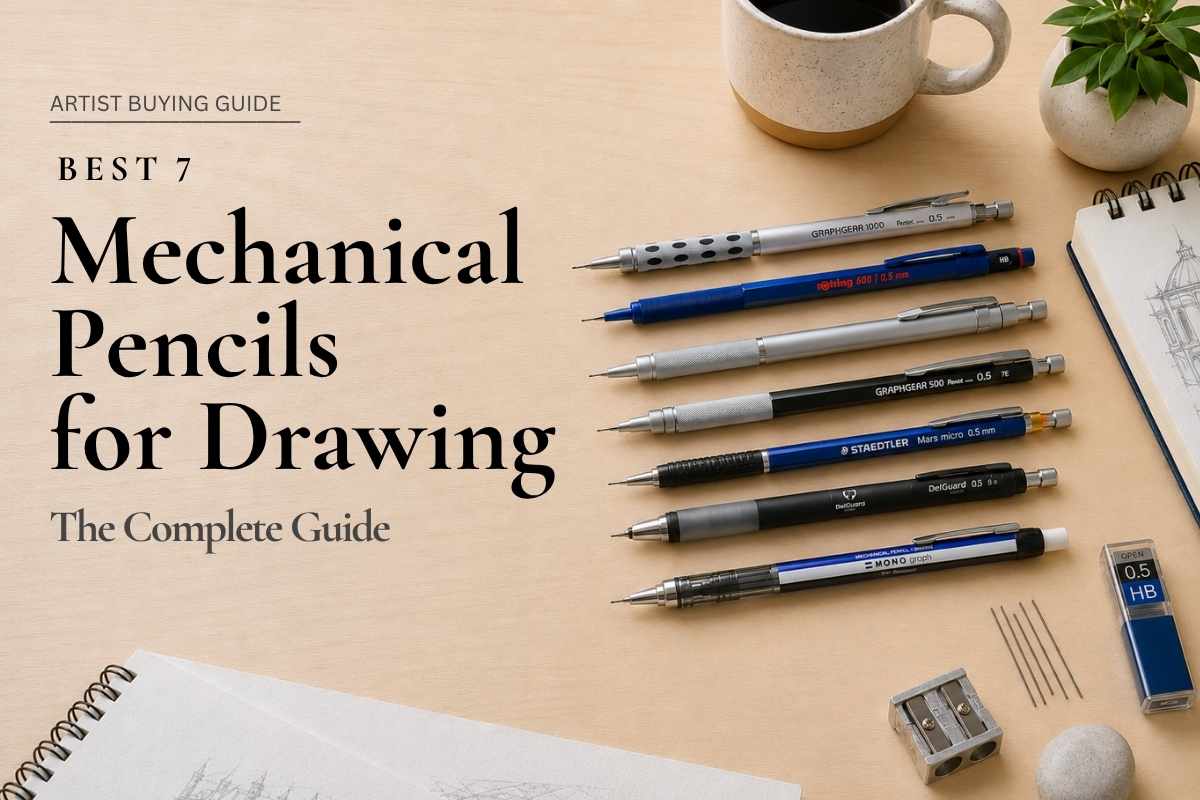
Introduction
When it comes to creating clean lines, detailed sketches, and consistent results, the Best Mechanical Pencils for Drawing offer advantages that traditional wooden pencils simply can’t match. Their precision, reliable lead advancement, and comfortable designs make them a favorite among professional artists, illustrators, architects, designers, and hobbyists alike.
Unlike conventional pencils that require constant sharpening, mechanical pencils for drawing maintain a consistent line width throughout your creative process. Whether you’re sketching realistic portraits, designing characters, practicing gesture drawings, or working on technical illustrations, the right pencil can improve both comfort and accuracy during long drawing sessions.
With so many options available—from lightweight plastic models to premium all-metal drafting pencils—finding the best mechanical pencil for drawing can feel overwhelming. Different artists have different preferences, including lead size, grip style, weight, and balance. A pencil that feels perfect for detailed line work may not be the ideal choice for loose sketching or expressive shading.
To help you make an informed decision, we’ve carefully selected the Best Mechanical Pencils for Drawing based on build quality, drawing performance, comfort, durability, and real-world popularity among artists. This guide features internationally recognized brands trusted by creatives around the world, making it easy to find a drawing mechanical pencil that suits your style and workflow.
Whether you’re an experienced illustrator searching for a premium drafting pencil or a beginner looking for a dependable everyday sketching tool, this guide highlights some of the finest mechanical pencils for artists available today. By the end, you’ll have a clear understanding of which model best fits your drawing needs and why it deserves a place in your art kit.
Quick Comparison: Best Mechanical Pencils for Drawing
| Mechanical Pencil | Best For | Lead Sizes | Body Material | Weight |
|---|---|---|---|---|
| Pentel GraphGear 1000 | Best Overall | 0.3, 0.5, 0.7, 0.9 mm | Aluminum & Metal | Medium |
| rOtring 600 | Best Premium | 0.35, 0.5, 0.7 mm | Full Metal | Heavy |
| Uni Kuru Toga Roulette | Consistent Fine Lines | 0.5 mm | Metal & Resin | Medium |
| Pentel GraphGear 500 | Lightweight Sketching | 0.3, 0.5, 0.7, 0.9 mm | Plastic & Metal Grip | Light |
| Staedtler Mars Micro | Technical Drawing | 0.3, 0.5, 0.7, 0.9 mm | Plastic | Medium |
| Zebra DelGuard Type-GR | Lead Protection | 0.5, 0.7 mm | Resin & Rubber Grip | Light |
| Tombow Mono Graph | Everyday Drawing | 0.5 mm | Plastic | Light |
Before diving into the detailed reviews, here’s a side-by-side look at my top picks. After years of sketching everything from quick gesture drawings to highly detailed portraits, I’ve found that each of these Best Mechanical Pencils for Drawing excels in a different area. Some are built for precision, while others are better suited for long, comfortable sketching sessions.
One thing I’ve learned over the years is that there isn’t a single “perfect” pencil for every artist. The best mechanical pencil for drawing depends on your workflow. If you’re an illustrator who spends hours refining line art, you’ll likely appreciate a heavier, well-balanced pencil like the rOtring 600. On the other hand, if you enjoy loose sketching or carry a sketchbook everywhere, a lighter option such as the Tombow Mono Graph or Pentel GraphGear 500 can be more comfortable over long sessions.
1. Pentel GraphGear 1000 – Best Overall Mechanical Pencil for Drawing
If someone asked me to recommend just one mechanical pencil without knowing anything about their drawing style, I’d hand them the Pentel GraphGear 1000.
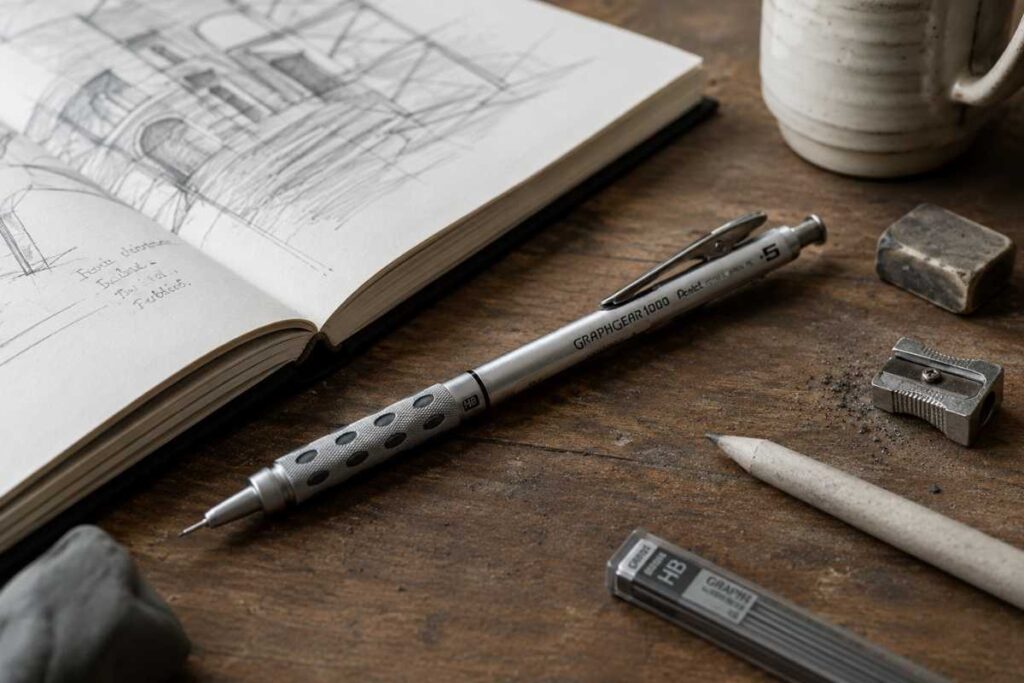
I’ve used this pencil for everything from quick thumbnail sketches to detailed graphite portraits, and it consistently delivers. It’s one of those rare tools that feels equally comfortable in a classroom, a professional studio, or an urban sketching kit. The balance is excellent, the grip feels secure without being overly aggressive, and the retractable lead sleeve is a feature I wish more manufacturers would adopt.
Unlike many mechanical pencils that feel either too light or unnecessarily heavy, the GraphGear 1000 strikes a balance that makes it easy to use for hours without feeling fatigued. Whether I’m working on construction lines, refining facial features, or adding fine texture to hair and fabric, the pencil responds exactly the way I expect.
Why It Stands Out
The first thing you’ll notice is the dual-textured metal grip. Pentel combines soft rubber pads with a knurled metal grip, giving you excellent control without the discomfort that some fully knurled grips can cause during long drawing sessions.
The retractable lead sleeve is another standout feature. If you’ve ever accidentally bent the tip of a drafting pencil while tossing it into your backpack, you’ll immediately appreciate this design. A simple click retracts the sleeve, making the pencil much safer to carry.
Available in multiple lead sizes—from ultra-fine 0.3 mm to bold 0.9 mm—it adapts easily to different drawing styles. Personally, I reach for the 0.5 mm version most often because it’s the sweet spot for everyday sketching, line work, and light shading.
Key Features
- Available in 0.3, 0.5, 0.7, and 0.9 mm
- Retractable lead sleeve protects the tip
- Comfortable dual-textured metal grip
- Well-balanced aluminum body
- Replaceable eraser under the cap
- Reliable click mechanism
Pros
- Excellent balance for extended drawing sessions
- Comfortable grip that reduces hand fatigue
- Retractable tip adds durability for travel
- Multiple lead sizes for different techniques
- Consistently smooth lead advancement
- Professional build quality
Cons
- Slightly more expensive than entry-level models
- The clip is sturdy but can feel firm when attaching to thicker sketchbook covers
My Experience
Over the years, I’ve recommended the GraphGear 1000 to students, hobbyists, and fellow artists more than any other mechanical pencil. It’s one of the few drawing tools that rarely disappoints because it doesn’t force you to adapt to the pencil—it simply gets out of your way and lets you focus on drawing.
During long portrait sessions, the balanced weight helps maintain control without making my hand feel tired. When working on architectural details or intricate cross-hatching, the tip remains stable enough that I never feel like I’m fighting the tool.
That’s why it continues to earn its place at the top of my list of the Best Mechanical Pencils for Drawing. It isn’t the flashiest pencil on the market, but it’s one of the most dependable—and in the studio, dependability matters more than gimmicks.
Best For: Artists who want one versatile mechanical pencil that performs exceptionally well across sketching, illustration, technical drawing, and everyday creative work.
2. rOtring 600 – Best Premium Mechanical Pencil for Drawing
If there’s one mechanical pencil that’s earned legendary status among artists, architects, and industrial designers, it’s the rOtring 600. I’ve owned mine for years, and it has survived countless sketchbook sessions, studio projects, and trips without missing a beat. It feels less like a disposable writing instrument and more like a precision tool that’s built to last.
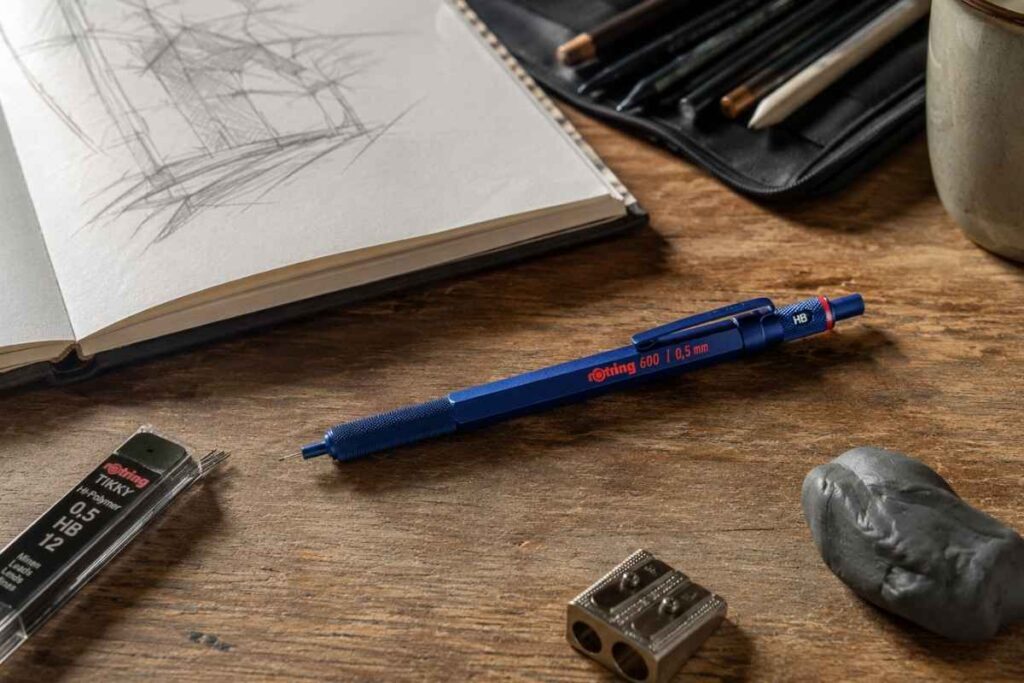
The first thing you’ll notice is the weight. Unlike lightweight plastic pencils, the rOtring 600 has a solid brass body that gives it a reassuring heft. That extra weight isn’t for everyone, but if you enjoy letting the pencil glide across the paper with minimal pressure, it can make long, controlled lines feel incredibly smooth.
For detailed illustrations and technical drawings, this is one of the best mechanical pencils for drawing because it stays remarkably stable in your hand. There’s very little flex in the tip, which translates into crisp, confident line work.
Why It Stands Out
The rOtring 600 is all about precision. Its hexagonal barrel prevents the pencil from rolling off your desk, while the knurled metal grip offers exceptional control. I especially appreciate this grip when working on detailed pen-and-pencil illustrations where even slight hand movement can affect the final result.
The pencil also has a fixed lead sleeve, which gives it excellent tip stability. That makes it ideal for rulers, templates, and highly detailed artwork. The downside is that you’ll want to be careful when carrying it in a bag since the sleeve doesn’t retract.
Where the GraphGear 1000 feels like an all-around performer, the rOtring 600 feels like a dedicated precision instrument. When I know I’ll be spending hours refining small details, this is usually the pencil I reach for.
Key Features
- Precision-machined brass body
- Hexagonal barrel prevents rolling
- Knurled metal grip for maximum control
- Fixed lead sleeve for accurate line work
- Available in 0.35, 0.5, and 0.7 mm
- Premium all-metal construction
Pros
- Outstanding build quality that lasts for years
- Excellent balance for slow, controlled drawing
- Extremely stable tip for fine detail
- Comfortable grip with plenty of control
- Classic design trusted by professionals worldwide
Cons
- Heavier than most mechanical pencils
- Fixed lead sleeve requires careful storage
- Higher price than many competitors
My Experience
Whenever I’m working on architectural sketches, intricate cross-hatching, or highly detailed graphite illustrations, the rOtring 600 gives me a level of confidence that’s hard to describe until you’ve used it.
The added weight means I don’t need to press as hard to maintain a consistent line. Instead, I can relax my grip and let the pencil do much of the work. That may not sound like a big difference, but after two or three hours of drawing, it noticeably reduces hand strain.
It’s also one of the few pencils that feels exactly the same after years of use. The click mechanism remains crisp, the grip hasn’t loosened, and the body has held up remarkably well despite regular use.
Who Should Buy It?
The rOtring 600 is best suited for artists who value precision over portability. If your work involves technical drawing, architectural rendering, product design, detailed illustrations, or clean line art, it’s an investment you’ll likely appreciate every time you sit down to draw.
If, however, you prefer quick gesture sketches or like carrying a pencil loose in your pocket, a lighter model with a retractable tip may be the better choice.
Best For: Professional artists, architects, designers, illustrators, and anyone who wants a premium mechanical pencil built for precision and long-term reliability.
Artist’s Verdict
The rOtring 600 isn’t the pencil I’d recommend to everyone—but for artists who appreciate craftsmanship, balance, and precision, it’s one of the finest drawing mechanical pencils ever made. It’s a tool that rewards careful, deliberate work, and it’s easy to see why it remains a favorite in studios around the world decades after its introduction.
3. Uni Kuru Toga Roulette – Best Mechanical Pencil for Consistent Fine Lines
One of the biggest frustrations with most mechanical pencils is how quickly the lead develops a flat edge. After a few strokes, your crisp, fine line becomes noticeably wider, forcing you to rotate the pencil in your fingers to regain a sharp point. If you’ve spent any time doing detailed illustrations, you’ll know exactly what I’m talking about.
That’s where the Uni Kuru Toga Roulette stands apart.
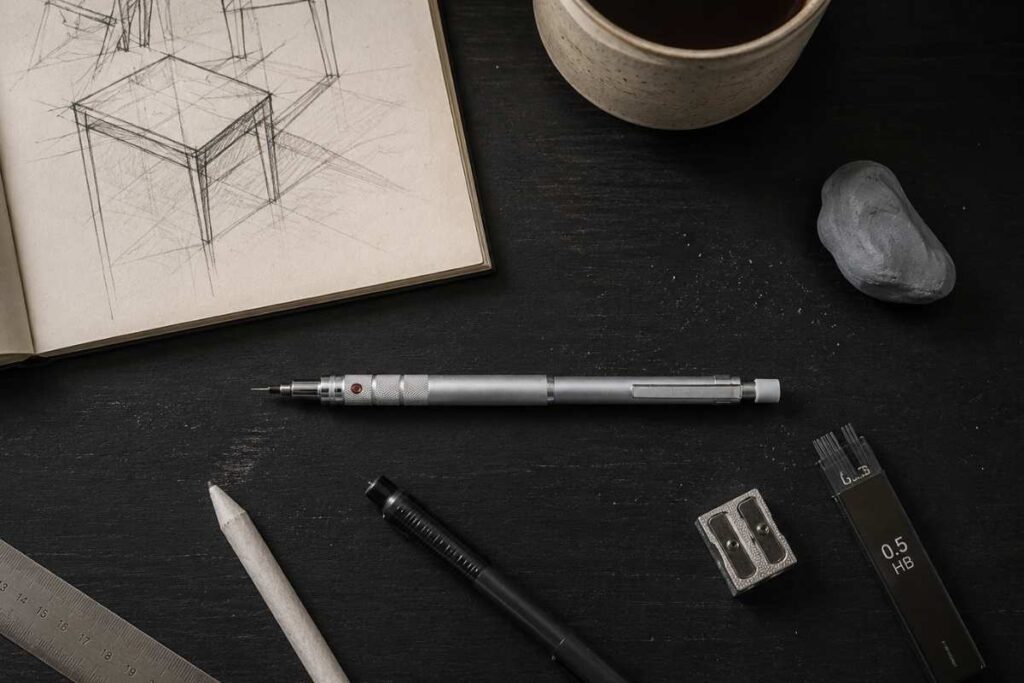
Its signature rotating lead mechanism slowly turns the lead as you draw, helping maintain a consistently sharp point. It’s a clever piece of engineering that actually makes a difference, especially if your work involves line art, technical sketches, manga, comics, or detailed illustrations.
Among the Best Mechanical Pencils for Drawing, this is one of the few that solves a problem most artists simply accept as normal.
Why It Stands Out
The Kuru Toga engine rotates the lead a tiny amount every time you lift the pencil from the paper. The movement is almost impossible to notice while drawing, but the result is immediately visible.
Instead of gradually producing thicker, uneven lines, the lead wears much more evenly. For artists who value consistency, this means less time rotating the pencil manually and more time focusing on the artwork.
The Roulette version also upgrades the standard Kuru Toga with a knurled metal grip, giving it a more premium feel and better control than the entry-level model.
Key Features
- Automatic lead rotation mechanism
- Knurled metal grip
- Lightweight yet well-balanced design
- Smooth click mechanism
- Available in 0.5 mm
- Replaceable eraser
Pros
- Keeps the lead sharper for longer
- Produces more consistent line widths
- Comfortable grip for detailed work
- Excellent for line art and illustration
- Lightweight enough for extended drawing sessions
- Smooth and reliable lead advancement
Cons
- Rotation mechanism is less noticeable during fast sketching
- Limited lead size options compared to some competitors
- Not ideal if you prefer broad, expressive pencil strokes
My Experience
I reach for the Uni Kuru Toga Roulette whenever I’m working on illustrations that demand clean, consistent lines. Character designs, comic pages, and architectural details are where this pencil really shines.
One project that stands out involved a series of detailed pen-and-pencil illustrations with intricate cross-hatching. Normally, I’d find myself subtly twisting the pencil every few minutes to keep the lead sharp. With the Kuru Toga Roulette, I hardly thought about it. The lines stayed remarkably consistent throughout the session, which made the drawing process feel smoother and less distracting.
That said, it’s not the pencil I choose for loose gesture drawing. During fast, sweeping sketches, the rotating mechanism doesn’t have as much opportunity to work because it relies on lifting the pencil between strokes. In those situations, I still prefer something like the Pentel GraphGear 1000.
Who Should Buy It?
If your artwork relies on precision—whether that’s manga, comics, technical illustrations, architectural drawings, or highly detailed graphite work—the Uni Kuru Toga Roulette is one of the smartest choices you can make.
Artists who spend hours refining line art will appreciate how consistently the pencil performs without requiring constant adjustments.
Best For: Illustrators, comic artists, manga creators, technical artists, and anyone who values clean, uniform line work.
Artist’s Verdict
The Uni Kuru Toga Roulette proves that thoughtful engineering can genuinely improve the drawing experience. Its rotating lead mechanism isn’t just a marketing feature—it solves a common issue that many artists deal with every day.
While it may not replace every pencil in your collection, it absolutely deserves a place among the Best Mechanical Pencils for Drawing if precision and consistent line quality are high on your priority list. For detailed illustrations and controlled line work, it’s one of the most enjoyable mechanical pencils for artists I’ve used.
4. Pentel GraphGear 500 – Best Lightweight Mechanical Pencil for Drawing
Not every great drawing pencil needs a premium price tag or a full metal body. The Pentel GraphGear 500 is proof that a well-designed mechanical pencil can deliver professional-level performance while staying lightweight and comfortable enough for everyday use.
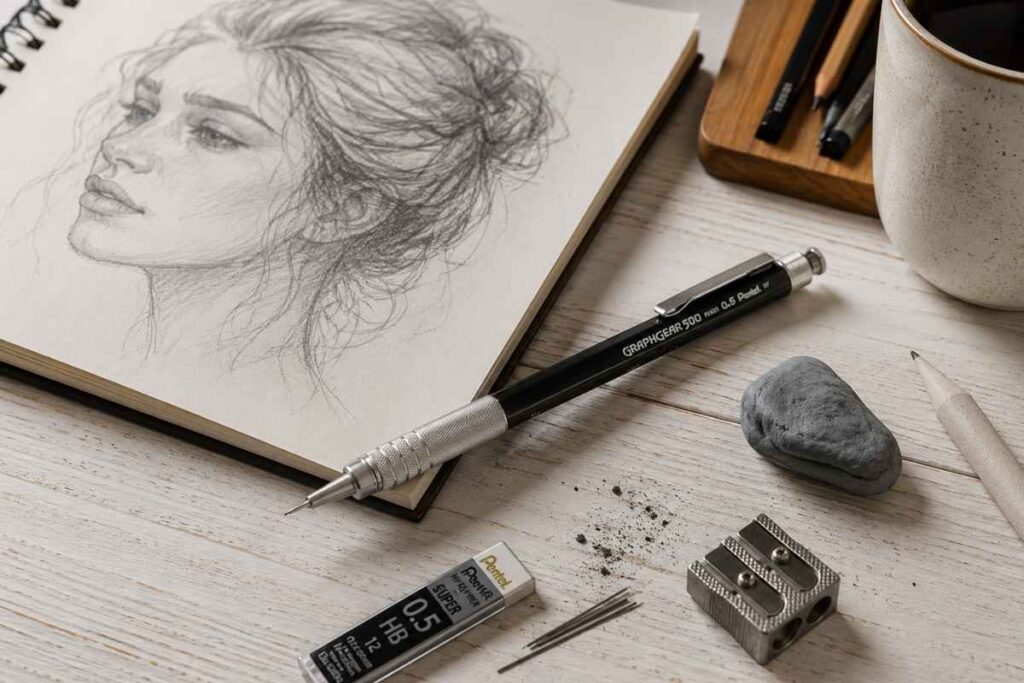
I’ve recommended this pencil to countless beginners over the years, but don’t let that fool you—it’s far from being a “starter” tool. In fact, I still keep one on my drawing desk because there are days when I simply want a pencil that feels effortless to use. Whether I’m filling pages with gesture sketches or exploring composition ideas in a sketchbook, the GraphGear 500 never feels like it’s slowing me down.
Among the Best Mechanical Pencils for Drawing, it’s one of the easiest pencils to pick up and use for hours without your hand feeling fatigued.
Why It Stands Out
The first thing you’ll notice is how light it feels compared to premium all-metal pencils. Instead of relying on weight for control, the GraphGear 500 focuses on balance. The plastic barrel keeps the overall weight down, while the knurled metal grip adds enough stability to maintain precise control over your lines.
That combination makes it especially enjoyable for long drawing sessions. If you’re the type of artist who can easily fill twenty or thirty sketchbook pages in one sitting, you’ll appreciate how little effort it takes to move this pencil across the paper.
Another feature I like is the fixed drafting tip. It provides a clear view of the page, making it easier to work with rulers, templates, or highly detailed illustrations.
Key Features
- Available in 0.3, 0.5, 0.7, and 0.9 mm
- Lightweight plastic barrel
- Knurled metal grip for added control
- Fixed drafting tip
- Reliable Pentel lead advancement mechanism
- Replaceable eraser
Pros
- Lightweight and comfortable for extended drawing sessions
- Excellent balance despite its simple construction
- Comfortable metal grip provides good control
- Available in multiple lead sizes
- Smooth and dependable lead advancement
- Outstanding value for its performance
Cons
- Plastic body doesn’t feel as premium as metal competitors
- Fixed lead sleeve requires careful storage
- Clip design is fairly basic
My Experience
Whenever I teach beginner drawing workshops, this is one of the pencils I often recommend because it allows students to focus on drawing instead of fighting with their tools.
Personally, I enjoy using the 0.5 mm version for daily sketchbook practice. It’s light enough that I can spend an afternoon exploring ideas without my hand feeling tired, yet stable enough to handle more refined work when I decide to develop a sketch further.
One thing I’ve always appreciated about Pentel is consistency. Whether you buy a GraphGear 500 today or replace it years later, the drawing experience remains remarkably familiar. That’s something I value because muscle memory plays a big role in developing confidence with your tools.
Who Should Buy It?
The GraphGear 500 is an excellent choice for artists who prefer lightweight tools or spend long hours sketching. It’s equally suitable for students, illustrators, hobbyists, and professionals looking for a dependable everyday drawing pencil.
If you don’t need the extra weight or premium construction of a metal-bodied pencil, the GraphGear 500 offers nearly everything you need for high-quality drawing performance.
Best For: Everyday sketching, gesture drawing, classroom use, illustration, and artists who prefer a lightweight mechanical pencil.
Artist’s Verdict
The Pentel GraphGear 500 has earned its reputation by doing the fundamentals exceptionally well. It isn’t flashy, and it doesn’t rely on innovative mechanisms or luxury materials. Instead, it delivers a balanced, comfortable drawing experience that keeps artists coming back year after year.
If you’re looking for a reliable addition to your collection of the Best Mechanical Pencils for Drawing, the GraphGear 500 is one of the strongest all-around options available. It offers the precision of a drafting pencil with the comfort needed for long creative sessions, making it one of my favorite mechanical pencils for artists who value practicality over unnecessary extras.
5. Staedtler Mars Micro – Best Mechanical Pencil for Technical Drawing
When precision matters more than anything else, few pencils have earned the trust of artists and designers quite like the Staedtler Mars Micro. Staedtler has been producing drafting tools for well over a century, and that experience is evident the moment you put this pencil to paper.
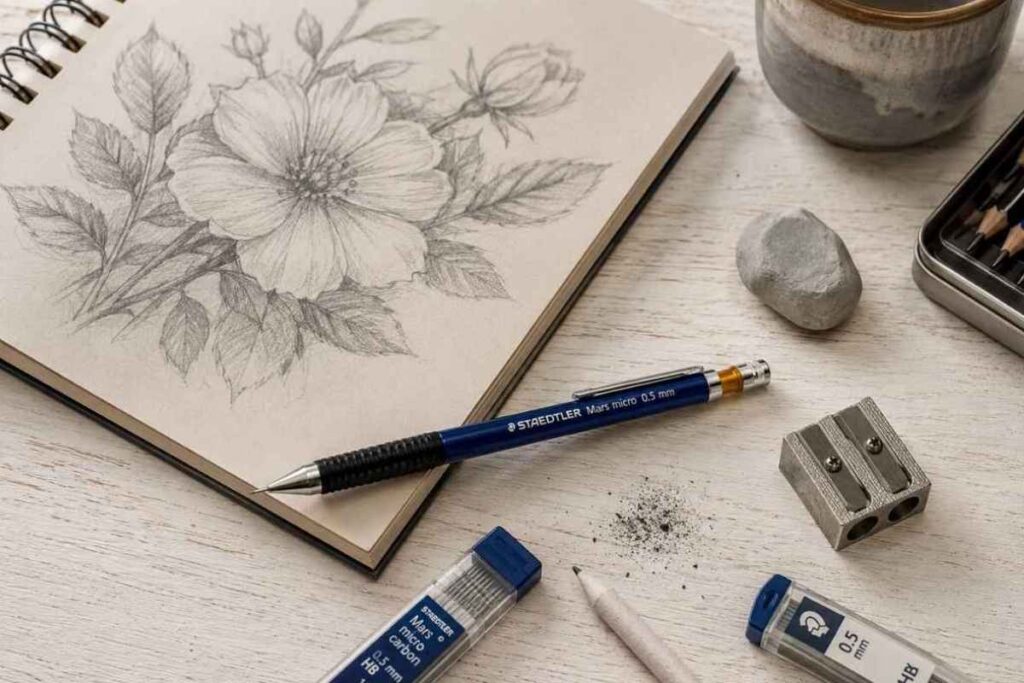
Although it’s often associated with architects and engineers, don’t overlook it as an artist. I’ve found the Mars Micro to be especially useful for perspective drawings, architectural sketches, product design concepts, and any artwork where accuracy and clean construction lines are essential.
Among the Best Mechanical Pencils for Drawing, this is the one I reach for when I know every line needs to land exactly where I intend.
Why It Stands Out
The Mars Micro isn’t designed to impress with flashy features. Instead, it focuses on reliability.
The lead advances smoothly, the tip remains stable, and the overall construction feels dependable from the first sketch to the last. It’s one of those pencils that quietly does its job without demanding attention, which is exactly what you want when you’re deep into a drawing.
I also appreciate how well-balanced it feels. While it doesn’t have the substantial weight of an all-metal drafting pencil, it never feels flimsy or cheap. The slightly textured grip provides enough traction for confident control without becoming uncomfortable during long sessions.
Another feature worth mentioning is the built-in lead hardness indicator. It may seem like a small detail, but if you regularly switch between HB, 2B, H, or other lead grades, it’s surprisingly convenient and helps keep your workflow organized.
Key Features
- Available in 0.3, 0.5, 0.7, and 0.9 mm
- Built-in lead hardness indicator
- Stable fixed lead sleeve
- Textured grip for better control
- Reliable click mechanism
- Replaceable eraser
Pros
- Exceptional precision for detailed drawings
- Stable tip produces clean, accurate lines
- Comfortable, well-balanced design
- Lead hardness indicator is genuinely useful
- Available in multiple lead sizes
- Excellent long-term reliability
Cons
- Fixed lead sleeve requires careful storage
- More functional than stylish in appearance
- Grip isn’t as aggressive as some premium drafting pencils
My Experience
I tend to use the Mars Micro whenever I’m laying out perspective grids or creating clean structural drawings before moving on to darker rendering.
One thing I’ve always appreciated is how predictable it feels. Every click advances the lead consistently, and the tip stays steady even during slow, deliberate line work. That consistency builds confidence, especially when you’re working on drawings that require precise measurements or carefully planned proportions.
I’ve also found it to be an excellent teaching pencil. Students who are learning perspective or technical drawing often benefit from using tools that don’t introduce unnecessary variables, and the Mars Micro does exactly that. It simply performs the way you expect every single time.
Who Should Buy It?
The Staedtler Mars Micro is an excellent choice for artists who enjoy technical illustration, architectural sketching, industrial design, product rendering, or any style of drawing that depends on precision.
It’s also a great option for artists who appreciate dependable tools over flashy designs. If your goal is accuracy rather than novelty, this pencil delivers.
Best For: Technical drawing, architectural sketches, industrial design, perspective studies, and precise line work.
Artist’s Verdict
The Staedtler Mars Micro may not receive as much attention as some of the newer mechanical pencils on the market, but it has earned its reputation through years of dependable performance. It’s a pencil that prioritizes precision, consistency, and reliability—qualities that every serious artist can appreciate.
If your work leans toward detailed line art, construction drawings, or technical illustration, the Mars Micro deserves a place among the Best Mechanical Pencils for Drawing. It’s a timeless drafting pencil that continues to prove why Staedtler remains one of the most respected names in professional art and design tools.
6. Zebra DelGuard Type-GR – Best Mechanical Pencil for Lead Protection
If you’ve ever been in the middle of a drawing only to have the lead snap repeatedly, you know how frustrating it can be. It interrupts your rhythm, wastes lead, and pulls your attention away from the artwork. That’s exactly the problem the Zebra DelGuard Type-GR was designed to solve.
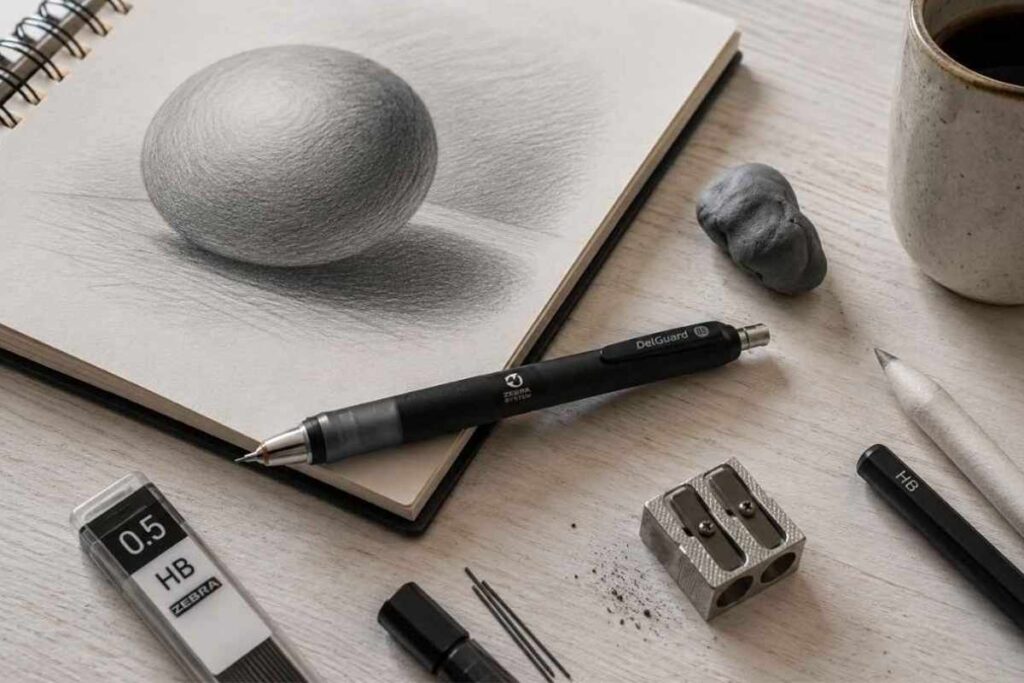
At first, I was skeptical. Many “breakthrough” pencil features sound great on paper but make little difference in actual use. After spending several weeks sketching with the DelGuard Type-GR, I changed my mind. Its lead protection system genuinely reduces breakage, especially during quick sketching sessions or when working with a heavier hand.
While it may not replace a premium drafting pencil for highly detailed illustration, it has absolutely earned its place among the Best Mechanical Pencils for Drawing, particularly for artists who value reliability and uninterrupted workflow.
Why It Stands Out
The DelGuard mechanism automatically cushions the lead whenever extra pressure is applied. Instead of snapping under stress, the internal spring system absorbs much of the force before it reaches the lead.
The result is surprisingly effective.
During everyday sketching, I noticed far fewer interruptions from broken lead, even when switching between lighter construction lines and darker, more confident strokes. It’s a subtle improvement, but over the course of a long drawing session, those small interruptions add up.
The Type-GR version also features a thicker rubber grip than the standard DelGuard model, making it noticeably more comfortable for extended use.
Key Features
- Patented DelGuard lead protection system
- Available in 0.5 mm and 0.7 mm
- Comfortable soft rubber grip
- Lightweight resin body
- Smooth lead advancement
- Replaceable eraser
Pros
- Greatly reduces lead breakage
- Comfortable grip for long drawing sessions
- Lightweight and easy to control
- Smooth, reliable click mechanism
- Excellent choice for everyday sketching
- Ideal for artists who tend to press harder
Cons
- Plastic body feels less premium than metal pencils
- Tip stability isn’t quite as rigid as dedicated drafting pencils
- Not intended for ultra-technical precision work
My Experience
I often recommend the Zebra DelGuard Type-GR to students because it removes one of the most common frustrations beginners experience—constantly breaking the lead.
Even as an experienced artist, I found myself appreciating the design more than I expected. During loose concept sketching, I naturally vary my drawing pressure without thinking about it. With many mechanical pencils, that occasionally results in a snapped lead. With the DelGuard, those interruptions became much less frequent.
I also enjoyed using it for outdoor sketching. It’s lightweight enough to carry all day, and the comfortable grip makes it easy to use during longer urban sketching sessions.
Would I choose it over a GraphGear 1000 for detailed portrait work? Probably not. But for everyday drawing and casual sketchbook practice, it’s an impressively dependable companion.
Who Should Buy It?
The Zebra DelGuard Type-GR is ideal for artists who break lead frequently, enjoy fast sketching, or simply want a pencil that lets them focus on drawing instead of constantly clicking out new lead.
It’s especially well suited for students, hobbyists, comic artists, and anyone who fills sketchbooks with quick ideas and exploratory drawings.
Best For: Everyday sketching, urban sketching, classroom use, concept art, and artists who want maximum lead durability.
Artist’s Verdict
The Zebra DelGuard Type-GR isn’t trying to compete with traditional drafting pencils on weight or premium construction. Instead, it solves a very real problem that many artists encounter every day, and it does so remarkably well.
If broken lead has ever interrupted your creative flow, this pencil is well worth considering. Its thoughtful engineering, comfortable grip, and dependable performance make it one of the most practical additions to this list of the Best Mechanical Pencils for Drawing. It’s a reminder that sometimes the best art tools aren’t the most complicated—they’re the ones that quietly help you keep creating.
7. Tombow Mono Graph – Best Everyday Mechanical Pencil for Drawing
Some mechanical pencils are designed for precision. Others are built for technical drafting. The Tombow Mono Graph takes a different approach—it focuses on making everyday drawing as effortless as possible.
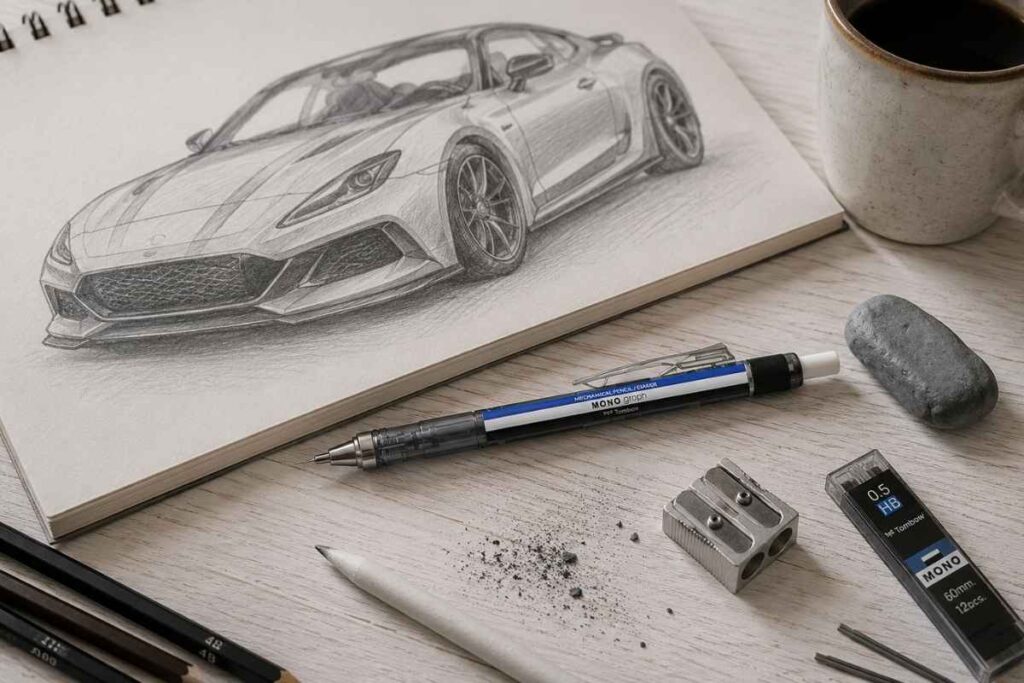
I’ve carried a Mono Graph in my sketch bag for years because it’s the kind of pencil you can grab without thinking. Whether I’m warming up with gesture drawings, filling a travel sketchbook, or brainstorming composition ideas before moving to a finished illustration, it consistently feels comfortable and dependable.
Among the Best Mechanical Pencils for Drawing, this is the pencil I’d recommend to artists who simply want a reliable tool they can use every day without constantly thinking about the mechanics.
Why It Stands Out
What immediately sets the Mono Graph apart is its thoughtful ergonomics. The lightweight body feels well balanced, and the grip naturally encourages a relaxed hand position. During long sketching sessions, that comfort makes a noticeable difference.
One feature I genuinely appreciate is the oversized twist eraser. Unlike the tiny erasers found on many mechanical pencils, the Mono Graph gives you a usable eraser that’s perfect for lifting construction lines or making quick corrections without reaching for a separate block eraser.
Another clever touch is Tombow’s shake mechanism. A gentle shake advances the lead, making it surprisingly convenient when you’re actively sketching. If you prefer a traditional click mechanism, you can lock the shaker and use it like a standard mechanical pencil.
It’s a small detail, but it shows that Tombow designed this pencil with everyday artists in mind.
Key Features
- Available in 0.5 mm
- Lightweight, well-balanced body
- Extra-long twist eraser
- Shake-to-advance lead mechanism
- Lockable shaker function
- Smooth lead advancement system
Pros
- Extremely comfortable for long sketching sessions
- Excellent oversized eraser
- Convenient shake mechanism
- Lightweight without feeling flimsy
- Reliable lead advancement
- Great everyday drawing companion
Cons
- Plastic construction lacks the premium feel of metal pencils
- Primarily available in 0.5 mm
- Shake mechanism may take a little getting used to
My Experience
The Mono Graph has become one of my favorite sketchbook pencils because it stays out of the way. That may sound like faint praise, but it’s actually one of the highest compliments I can give an art tool.
When I’m exploring ideas, I don’t want to think about the pencil—I want to think about the drawing.
The lightweight design allows me to move quickly across the page, making it especially enjoyable for gesture drawing and loose concept sketches. The large eraser also gets used far more often than I expected. It’s surprisingly effective for cleaning up construction lines before adding darker details.
Over time, I found myself reaching for the Mono Graph whenever I wanted a pencil that felt comfortable, predictable, and easy to use. It may not have the engineering sophistication of the Kuru Toga or the precision-focused build of the rOtring 600, but it succeeds by doing the basics exceptionally well.
Who Should Buy It?
The Tombow Mono Graph is an excellent choice for artists looking for a dependable everyday mechanical pencil. It’s particularly well suited for sketchbook artists, illustrators, students, urban sketchers, and anyone who values comfort over technical complexity.
If your drawing sessions involve quick ideas, thumbnail sketches, daily practice, or relaxed illustration work, this pencil is easy to recommend.
Best For: Daily sketching, travel sketchbooks, gesture drawing, illustration, and general creative work.
Artist’s Verdict
The Tombow Mono Graph proves that a great drawing pencil doesn’t need to be complicated. Its comfortable design, practical features, and dependable performance make it one of the most enjoyable mechanical pencils for artists who draw regularly.
While it isn’t intended to replace a premium drafting pencil, it absolutely deserves a place among the Best Mechanical Pencils for Drawing. It’s the kind of tool that quietly becomes part of your daily routine—always ready when inspiration strikes, whether you’re filling a sketchbook at your desk or capturing ideas on the go.
Mechanical Pencil Lead Sizes Explained
One of the questions I’m asked most often by students is, “What lead size should I buy?” The truth is, there isn’t a single correct answer. The best lead size depends on the way you draw, the amount of detail you like to include, and how much pressure you naturally apply while sketching.
If you’re looking for the Best Mechanical Pencils for Drawing, choosing the right lead size is just as important as choosing the pencil itself. Even the highest-quality mechanical pencil won’t perform at its best if the lead size doesn’t match your drawing style.
Here’s a closer look at the most common lead sizes and where each one shines.
0.3 mm – Best for Ultra-Fine Detail
The 0.3 mm lead is all about precision. It creates crisp, delicate lines that are perfect for highly detailed illustrations, technical drawings, and intricate textures.
When I’m rendering fine details like individual strands of hair, architectural elements, or intricate patterns, a 0.3 mm pencil allows me to work with remarkable accuracy. However, it also requires a lighter touch. Press too hard, and you’re more likely to experience lead breakage.
Best for:
- Fine line illustrations
- Architectural drawings
- Technical drafting
- Detailed cross-hatching
- Intricate textures
0.5 mm – The Best All-Around Choice
If I could only own one lead size, it would be 0.5 mm.
It’s the perfect balance between precision and versatility, making it my go-to choice for everyday drawing. Whether I’m sketching portraits, designing characters, creating landscapes, or filling pages in a sketchbook, 0.5 mm handles nearly everything with ease.
This is also the lead size I recommend to most artists because it’s widely available and works beautifully for both beginners and professionals.
Many of the Best Mechanical Pencils for Drawing are offered in 0.5 mm because it’s such a versatile option.
Best for:
- Everyday sketching
- Portrait drawing
- Character design
- Illustration
- General art practice
- Mixed drawing techniques
0.7 mm – Best for Sketching and Shading
Artists who prefer darker, more expressive lines often gravitate toward 0.7 mm lead.
The thicker lead is noticeably stronger than 0.3 mm or 0.5 mm, making it less prone to breaking under pressure. If you naturally draw with a heavier hand or enjoy building rich values through repeated strokes, you’ll likely appreciate the added durability.
I often switch to 0.7 mm when working on loose concept sketches or studies where precision isn’t the priority. It produces bold, confident marks that feel more relaxed and expressive.
Best for:
- Gesture drawing
- Loose sketching
- Value studies
- Shading
- Artists with a heavier drawing pressure
0.9 mm – Best for Bold, Expressive Drawing
Although it’s less common among illustrators, 0.9 mm has its place in an artist’s toolkit.
The thicker lead creates broad, confident lines that work well for rough layouts, expressive sketching, and large-format drawings. It’s also the most durable option, making it ideal for artists who frequently break thinner leads.
While I don’t use 0.9 mm every day, I enjoy it for quick concept sketches where capturing movement and composition matters more than fine detail.
Best for:
- Rough sketches
- Bold line work
- Large drawings
- Expressive concepts
- Heavy-handed artists
Which Lead Size Do I Recommend?
After years of drawing with nearly every lead size available, here’s the advice I give most often:
- Choose 0.3 mm if your work is highly detailed and demands maximum precision.
- Choose 0.5 mm if you want the most versatile option for everyday drawing.
- Choose 0.7 mm if you enjoy sketching, shading, and creating bolder lines.
- Choose 0.9 mm if you prefer expressive drawings or tend to apply heavier pressure.
For most artists, 0.5 mm remains the sweet spot. It offers an excellent balance of accuracy, durability, and versatility, which is why it’s the size I reach for most often and the one featured in many of the Best Mechanical Pencils for Drawing reviewed in this guide.
Ultimately, the right lead size comes down to your personal drawing style. As your skills evolve, you may even find yourself using multiple lead sizes depending on the project—just as many professional artists do.
Lead Grades Explained: Choosing the Right Graphite for Drawing
While most artists spend a lot of time choosing the right mechanical pencil, many overlook something that’s just as important—the graphite inside it.
Over the years, I’ve found that changing the lead grade can have a bigger impact on a drawing than switching to a different pencil. The same mechanical pencil can feel completely different depending on whether it’s loaded with an H, HB, 2B, or 4B lead.
If you’re investing in one of the Best Mechanical Pencils for Drawing, pairing it with the right lead grade will help you get the most out of your pencil.
H Lead – Best for Construction Lines
The “H” stands for Hard.
Harder leads create lighter, cleaner lines because they deposit less graphite onto the paper. They also keep a sharper point longer, making them excellent for precision work.
When I’m planning a complex drawing, I often begin with H lead because the construction lines stay subtle and don’t compete with the finished artwork. They’re also easier to draw over with darker grades later.
Best for:
- Construction sketches
- Perspective grids
- Technical drawing
- Architectural work
- Light guidelines
HB Lead – The Everyday Standard
HB is the lead grade most mechanical pencils include by default, and for good reason.
It strikes an excellent balance between hardness and darkness, making it versatile enough for almost any type of drawing. If I’m carrying only one pencil while traveling or sketching outdoors, it’s usually loaded with HB lead.
For most artists, HB is a reliable starting point before experimenting with softer or harder grades.
Best for:
- Everyday sketching
- General illustration
- Classroom practice
- Mixed drawing techniques
- Daily sketchbook work
B Lead – Richer, Darker Lines
B lead is slightly softer than HB, which means it produces darker, smoother marks with less pressure.
This is often my preferred choice for finished sketches because it allows me to build stronger contrast while still maintaining good control.
If your drawings tend to look too light or lack depth, switching from HB to B lead can make an immediate difference.
Best for:
- Finished sketches
- Character design
- Portrait drawing
- Line art
- Everyday illustration
2B Lead – Excellent for Shading
Once you move into 2B territory, you’ll notice a significant increase in graphite richness.
The softer lead glides across the paper more smoothly, making it much easier to create deep shadows and gradual value transitions.
When I’m rendering portraits or adding depth to landscapes, 2B is usually my first choice. It blends beautifully while still holding enough of a point for controlled detail.
One thing to keep in mind is that softer leads wear down faster, so you’ll advance the lead more often during long drawing sessions.
Best for:
- Portraits
- Shading
- Value studies
- Expressive sketching
- Tonal rendering
4B Lead – Deep, Dramatic Values
If you enjoy bold contrast and rich, velvety blacks, 4B is worth exploring.
This grade lays down a generous amount of graphite with very little pressure, making it ideal for dramatic lighting and high-contrast artwork. I don’t use it for every drawing, but when I want strong visual impact, it’s one of my favorite choices.
The trade-off is that softer leads can smudge more easily and require a lighter touch to avoid excessive wear.
Best for:
- Dramatic shading
- High-contrast drawings
- Dark backgrounds
- Expressive artwork
- Final value development
Which Lead Grade Do I Recommend?
If you’re just starting out, don’t overcomplicate it.
Here’s the combination I recommend most often:
- H for planning and construction lines
- HB for everyday sketching
- B for finished line work
- 2B for shading and richer values
- 4B for deep shadows and expressive contrast
Personally, I keep both HB and 2B loaded in different mechanical pencils. That combination handles nearly everything I draw, from quick concept sketches to finished graphite illustrations.
No matter which of the Best Mechanical Pencils for Drawing you choose, experimenting with different lead grades will help you discover what feels most natural for your style. In my experience, finding the right graphite is every bit as important as finding the right pencil, and together they can noticeably improve both your workflow and the quality of your finished artwork.